The problem is in standard form, so we just write down the tableau as
\begin{equation*}
\left[\begin{array}{rrr|rrrr|r} 1 \amp 7 \amp 3 \amp 1 \amp 0 \amp 0 \amp 0 \amp 53\\ 5 \amp 5 \amp 0 \amp 0 \amp 1 \amp 0 \amp 0 \amp 51\\ 8 \amp 0 \amp 4 \amp 0 \amp 0 \amp 1 \amp 0 \amp 64\\ \hline -3 \amp -6 \amp -5 \amp 0 \amp 0 \amp 0 \amp 1 \amp 0\\ \end{array} \right]
\end{equation*}
and then perform the following pivots (again not showing all of the details)
\begin{equation*}
\begin{array}{r} 3 \mapsto 6, \\ 2 \mapsto 4, \end{array} \qquad \left[\begin{array}{rrr|rrrr|r} -20 \amp 28 \amp 0 \amp 4 \amp 0 \amp -3 \amp 0 \amp 20\\ 240 \amp 0 \amp 0 \amp -20 \amp 28 \amp 15 \amp 0 \amp 1328\\ 56 \amp 0 \amp 28 \amp 0 \amp 0 \amp 7 \amp 0 \amp 448\\ \hline 76 \amp 0 \amp 0 \amp 24 \amp 0 \amp 17 \amp 28 \amp 2360\\ \end{array} \right]
\end{equation*}
This has the basic solution
\begin{equation*}
\begin{aligned} \boldsymbol{x} \amp = \frac{1}{28}\left[ \begin{array}{rrr|rrr} 0 \amp 20 \amp 448 \amp 0 \amp 1328 \amp 0 \end{array} \right] \\ \amp \approx \left[ \begin{array}{rrr|rrr} 0 \amp 0.714 \amp 16 \amp 0 \amp 47.43 \amp 0 \end{array} \right] \end{aligned}
\end{equation*}
So this is not integral, so we will form two problems. This solution has
\(x_1=0\text{,}\) which is an integer, so start with
\(x_2\) and add the two constraints:
\(x_2 \leq 0\) and
\(x_2 \geq 1\) in order to eliminate the current solution for
\(x_2\text{.}\) These problems are
Problem 4.3.11. PA.
\begin{equation*}
\begin{aligned} \text{Maximize} \amp\amp z = 3x_1 +6x_2 + 5 x_3, \amp\\ \text{such that} \amp\amp x_1 + 7 x_2 + 3x_3 \amp \leq 53, \\ \amp\amp 5 x_1 + 5 x_2 \amp \leq 51, \\ \amp\amp 8 x_1 + 4x_3 \amp \leq 65, \\ \amp \amp x_2 \amp \leq 0, \\ \text{and} \amp\amp x_1, x_2, x_3 \amp \in \mathbb{N}_{0}.
\end{aligned}
\end{equation*}
Problem 4.3.12. PB.
\begin{equation*}
\begin{aligned} \text{Maximize} \amp\amp z = 3x_1 +6x_2 + 5 x_3, \amp\\ \text{such that} \amp\amp x_1 + 7 x_2 + 3x_3 \amp \leq 53, \\ \amp\amp 5 x_1 + 5 x_2 \amp \leq 51, \\ \amp\amp 8 x_1 + 4x_3 \amp \leq 65, \\ \amp \amp x_2 \amp \geq 1, \\ \text{and} \amp\amp x_1, x_2, x_3 \amp \in \mathbb{N}_0.
\end{aligned}
\end{equation*}
The solution to
PA is found by starting with the simplex tableau:
\begin{equation*}
\left[\begin{array}{rrr|rrrrr|r} 1 \amp 7 \amp 3 \amp 1 \amp 0 \amp 0 \amp 0 \amp 0 \amp 53\\ 5 \amp 5 \amp 0 \amp 0 \amp 1 \amp 0 \amp 0 \amp 0 \amp 51\\ 8 \amp 0 \amp 4 \amp 0 \amp 0 \amp 1 \amp 0 \amp 0 \amp 64\\ 0 \amp 1 \amp 0 \amp 0 \amp 0 \amp 0 \amp 1 \amp 0 \amp 0\\ \hline -3 \amp -6 \amp -5 \amp 0 \amp 0 \amp 0 \amp 0 \amp 1 \amp 0\\ \end{array} \right]
\end{equation*}
and then perform the following pivots to get the optimal tableau:
\begin{equation*}
\begin{array}{r} 3 \mapsto 6, \\ 2 \mapsto 7, \end{array} \qquad \left[\begin{array}{rrr|rrrrr|r} -20 \amp 0 \amp 0 \amp 4 \amp 0 \amp -3 \amp -28 \amp 0 \amp 20\\ 20 \amp 0 \amp 0 \amp 0 \amp 4 \amp 0 \amp -20 \amp 0 \amp 204\\ 8 \amp 0 \amp 4 \amp 0 \amp 0 \amp 1 \amp 0 \amp 0 \amp 64\\ 0 \amp 4 \amp 0 \amp 0 \amp 0 \amp 0 \amp 4 \amp 0 \amp 0\\ \hline 28 \amp 0 \amp 0 \amp 0 \amp 0 \amp 5 \amp 24 \amp 4 \amp 320\\ \end{array} \right]
\end{equation*}
and this has the optimal solution:
\begin{equation*}
\begin{aligned} \boldsymbol{x} \amp = \frac{1}{4} \left[\begin{array}{rrr|rrrr} 0 \amp 0 \amp 65 \amp 17 \amp 204 \amp 0 \amp 0 \end{array}\right] \\ \amp = \left[\begin{array}{rrr|rrrr} 0 \amp 0 \amp 16.25 \amp 4.25 \amp 51 \amp 0 \amp 0 \end{array}\right] \end{aligned}
\end{equation*}
Next, return to the simplex tableau corresponding to problem
PB, which has the following simplex tableau:
\begin{equation*}
\left[\begin{array}{rrr|rrrrr|r} 1 \amp 7 \amp 3 \amp 1 \amp 0 \amp 0 \amp 0 \amp 0 \amp 53\\ 5 \amp 5 \amp 0 \amp 0 \amp 1 \amp 0 \amp 0 \amp 0 \amp 51\\ 8 \amp 0 \amp 4 \amp 0 \amp 0 \amp 1 \amp 0 \amp 0 \amp 64\\ 0 \amp -1 \amp 0 \amp 0 \amp 0 \amp 0 \amp 1 \amp 0 \amp -1\\ \hline -3 \amp -6 \amp -5 \amp 0 \amp 0 \amp 0 \amp 0 \amp 1 \amp 0\\ \end{array} \right]
\end{equation*}
where note that the inequality
\(x_2 \geq 1\) has been put into standard form.
The pivots that first make the tableau feasible, then finds the optimal solution are
\begin{equation*}
\begin{array}{r} 2 \mapsto 7, \\ 1 \mapsto 6, \\ 3 \mapsto 4, \end{array} \qquad \left[\begin{array}{rrr|rrrrr|r} 0 \amp 0 \amp 20 \amp 8 \amp 0 \amp -1 \amp 56 \amp 0 \amp 304\\ 0 \amp 0 \amp 0 \amp 20 \amp 20 \amp -15 \amp 240 \amp 0 \amp 880\\ 20 \amp 0 \amp 0 \amp -4 \amp 0 \amp 3 \amp -28 \amp 0 \amp 8\\ 0 \amp 20 \amp 0 \amp 0 \amp 0 \amp 0 \amp -20 \amp 0 \amp 20\\ \hline 0 \amp 0 \amp 0 \amp 28 \amp 0 \amp 4 \amp 76 \amp 20 \amp 1664\\ \end{array} \right]
\end{equation*}
which has the basic solution
\begin{equation*}
\begin{aligned} \boldsymbol{x} = \amp \frac{1}{20} \left[ \begin{array}{rrr|rrrr} 8 \amp 20 \amp 304 \amp 0 \amp 880 \amp 0 \amp 0 \end{array} \right] \\ \approx \amp \left[ \begin{array}{rrr|rrrr} 0.4 \amp 1 \amp 15.2 \amp 0 \amp 44 \amp 0 \amp 0 \end{array} \right] \end{aligned}
\end{equation*}
which is not integral. We need to do another level. First, let’s define
PAA and
PAB as the two problems that split the feasible set of
PA. Since
\(x_1\) and
\(x_2\) are both integers, we will split the feasible set of
PAA using
\(x_3\) and the two constraints
\(x_3 \leq 16\) and
\(x_3 \geq 17\text{.}\)
Problem 4.3.13. PAA.
\begin{equation*}
\begin{aligned} \text{Maximize} \amp\amp z = 3x_1 +6x_2 + 5 x_3, \amp\\ \text{such that} \amp\amp x_1 + 7 x_2 + 3x_3 \amp \leq 53, \\ \amp\amp 5 x_1 + 5 x_2 \amp \leq 51, \\ \amp\amp 8 x_1 + 4x_3 \amp \leq 65, \\ \amp\amp x_2 \amp \leq 0, \\ \amp \amp x_3 \amp \geq 17, \\ \text{and} \amp\amp x_1, x_2, x_3 \amp \in \mathbb{N}_{0}.
\end{aligned}
\end{equation*}
Problem 4.3.14. PAB.
\begin{equation*}
\begin{aligned} \text{Maximize} \amp\amp z = 3x_1 +6x_2 + 5 x_3, \amp\\ \text{such that} \amp\amp x_1 + 7 x_2 + 3x_3 \amp \leq 53, \\ \amp\amp 5 x_1 + 5 x_2 \amp \leq 51, \\ \amp\amp 8 x_1 + 4x_3 \amp \leq 65, \\ \amp\amp x_2 \amp \leq 0, \\ \amp \amp x_3 \amp \leq 16, \\ \text{and} \amp\amp x_1, x_2, x_3 \amp \in \mathbb{N}_{0}.
\end{aligned}
\end{equation*}
The solution to
PAA is found by starting with the simplex tableau:
\begin{equation*}
\left[\begin{array}{rrr|rrrrrr|r} 1 \amp 7 \amp 3 \amp 1 \amp 0 \amp 0 \amp 0 \amp 0 \amp 0 \amp 53\\ 5 \amp 5 \amp 0 \amp 0 \amp 1 \amp 0 \amp 0 \amp 0 \amp 0 \amp 51\\ 8 \amp 0 \amp 4 \amp 0 \amp 0 \amp 1 \amp 0 \amp 0 \amp 0 \amp 64\\ 0 \amp 1 \amp 0 \amp 0 \amp 0 \amp 0 \amp 1 \amp 0 \amp 0 \amp 0\\ 0 \amp 0 \amp -1 \amp 0 \amp 0 \amp 0 \amp 0 \amp 0 \amp 1 \amp -17\\ \hline -3 \amp -6 \amp -5 \amp 0 \amp 0 \amp 0 \amp 0 \amp 0 \amp 1 \amp 0\\ \end{array} \right]
\end{equation*}
and then one pivot results in the tableau
\begin{equation*}
3 \mapsto 8, \qquad \left[\begin{array}{rrr|rrrrrr|r} 1 \amp 7 \amp 0 \amp 1 \amp 0 \amp 0 \amp 0 \amp 3 \amp 0 \amp 2\\ 5 \amp 5 \amp 0 \amp 0 \amp 1 \amp 0 \amp 0 \amp 0 \amp 0 \amp 51\\ 8 \amp 0 \amp 0 \amp 0 \amp 0 \amp 1 \amp 0 \amp 4 \amp 0 \amp -4\\ 0 \amp 1 \amp 0 \amp 0 \amp 0 \amp 0 \amp 1 \amp 0 \amp 0 \amp 0\\ 0 \amp 0 \amp 1 \amp 0 \amp 0 \amp 0 \amp 0 \amp -1 \amp 0 \amp 17\\ \hline -3 \amp -6 \amp 0 \amp 0 \amp 0 \amp 0 \amp 0 \amp -5 \amp 1 \amp 85\\ \end{array} \right]
\end{equation*}
and from the 3rd row, there is no positive ratio of last column to parameter coefficients, so this tableau is infeasible.
Next, return to the simplex tableau corresponding to problem
PAB, which has the following simplex tableau:
\begin{equation*}
\left[\begin{array}{rrr|rrrrrr|r} 1 \amp 7 \amp 3 \amp 1 \amp 0 \amp 0 \amp 0 \amp 0 \amp 0 \amp 53\\ 5 \amp 5 \amp 0 \amp 0 \amp 1 \amp 0 \amp 0 \amp 0 \amp 0 \amp 51\\ 8 \amp 0 \amp 4 \amp 0 \amp 0 \amp 1 \amp 0 \amp 0 \amp 0 \amp 64\\ 0 \amp 1 \amp 0 \amp 0 \amp 0 \amp 0 \amp 1 \amp 0 \amp 0 \amp 0\\ 0 \amp 0 \amp 1 \amp 0 \amp 0 \amp 0 \amp 0 \amp 1 \amp 0 \amp 16\\ \hline -3 \amp -6 \amp -5 \amp 0 \amp 0 \amp 0 \amp 0 \amp 0 \amp 1 \amp 0\\ \end{array} \right]
\end{equation*}
Applying the simplex method, we arrive at the following tableau:
\begin{equation*}
\begin{array}{r} 3 \mapsto 6, \\ 2 \mapsto 7, \end{array} \qquad \left[\begin{array}{rrr|rrrrrr|r} -20 \amp 0 \amp 0 \amp 4 \amp 0 \amp -3 \amp -28 \amp 0 \amp 0 \amp 20\\ 20 \amp 0 \amp 0 \amp 0 \amp 4 \amp 0 \amp -20 \amp 0 \amp 0 \amp 204\\ 8 \amp 0 \amp 4 \amp 0 \amp 0 \amp 1 \amp 0 \amp 0 \amp 0 \amp 64\\ 0 \amp 4 \amp 0 \amp 0 \amp 0 \amp 0 \amp 4 \amp 0 \amp 0 \amp 0\\ -8 \amp 0 \amp 0 \amp 0 \amp 0 \amp -1 \amp 0 \amp 4 \amp 0 \amp 0\\ \hline 28 \amp 0 \amp 0 \amp 0 \amp 0 \amp 5 \amp 24 \amp 0 \amp 4 \amp 320\\ \end{array} \right]
\end{equation*}
which has the basic solution
\begin{equation*}
\begin{aligned} \boldsymbol{x} \amp = \frac{1}{4} \left[\begin{array}{rrr|rrrrr} 0 \amp 0 \amp 64 \amp 20 \amp 204 \amp 0 \amp 0 \end{array}\right] \\ \amp = \left[\begin{array}{rrr|rrrr} 0 \amp 0 \amp 16 \amp 5 \amp 51 \amp 0 \amp 0 \end{array}\right] \end{aligned}
\end{equation*}
which is an integer solution. The objective value of this solution is
\(320/4=80\text{.}\)
Next, the problem
PB is split into two problems,
PBA and
PBB, where the feasible set of
PBA is split using
\(x_1 \leq 0\) and
\(x_1 \geq 1\text{.}\)
Problem 4.3.15. PBA.
\begin{equation*}
\begin{aligned} \text{Maximize} \amp\amp z = 3x_1 +6x_2 + 5 x_3, \amp\\ \text{such that} \amp\amp x_1 + 7 x_2 + 3x_3 \amp \leq 53, \\ \amp\amp 5 x_1 + 5 x_2 \amp \leq 51, \\ \amp\amp 8 x_1 + 4x_3 \amp \leq 65, \\ \amp\amp x_2 \amp \geq 1, \\ \amp\amp x_1 \amp \leq 0, \\ \text{and} \amp\amp x_1, x_2, x_3 \amp \in \mathbb{N}_{0}.
\end{aligned}
\end{equation*}
Problem 4.3.16. PBB.
\begin{equation*}
\begin{aligned} \text{Maximize} \amp\amp z = 3x_1 +6x_2 + 5 x_3, \amp\\ \text{such that} \amp\amp x_1 + 7 x_2 + 3x_3 \amp \leq 53, \\ \amp\amp 5 x_1 + 5 x_2 \amp \leq 51, \\ \amp\amp 8 x_1 + 4x_3 \amp \leq 65, \\ \amp\amp x_2 \amp \geq 1, \\ \amp\amp x_1 \amp \geq 1, \\ \text{and} \amp\amp x_1, x_2, x_3 \amp \in \mathbb{N}_{0}.
\end{aligned}
\end{equation*}
The solution to
PBA is found by starting with the simplex tableau:
\begin{equation*}
\left[\begin{array}{rrr|rrrrrr|r} 1 \amp 7 \amp 3 \amp 1 \amp 0 \amp 0 \amp 0 \amp 0 \amp 0 \amp 53\\ 5 \amp 5 \amp 0 \amp 0 \amp 1 \amp 0 \amp 0 \amp 0 \amp 0 \amp 51\\ 8 \amp 0 \amp 4 \amp 0 \amp 0 \amp 1 \amp 0 \amp 0 \amp 0 \amp 64\\ 0 \amp -1 \amp 0 \amp 0 \amp 0 \amp 0 \amp 1 \amp 0 \amp 0 \amp -1\\ 1 \amp 0 \amp 0 \amp 0 \amp 0 \amp 0 \amp 0 \amp 1 \amp 0 \amp 0\\ \hline -3 \amp -6 \amp -5 \amp 0 \amp 0 \amp 0 \amp 0 \amp 0 \amp 1 \amp 0\\ \end{array} \right]
\end{equation*}
and then apply the simplex method to get the following tableau:
\begin{equation*}
\begin{array}{r} 2 \mapsto 7, \\ 1 \mapsto 8, \\ 3 \mapsto 4, \end{array} \qquad \left[\begin{array}{rrr|rrrrrr|r} 0 \amp 0 \amp 3 \amp 1 \amp 0 \amp 0 \amp 7 \amp -1 \amp 0 \amp 46\\ 0 \amp 0 \amp 0 \amp 0 \amp 3 \amp 0 \amp 15 \amp -15 \amp 0 \amp 138\\ 0 \amp 0 \amp 0 \amp -4 \amp 0 \amp 3 \amp -28 \amp -20 \amp 0 \amp 8\\ 0 \amp 3 \amp 0 \amp 0 \amp 0 \amp 0 \amp -3 \amp 0 \amp 0 \amp 3\\ 3 \amp 0 \amp 0 \amp 0 \amp 0 \amp 0 \amp 0 \amp 3 \amp 0 \amp 0\\ \hline 0 \amp 0 \amp 0 \amp 5 \amp 0 \amp 0 \amp 17 \amp 4 \amp 3 \amp 248\\ \end{array} \right]
\end{equation*}
The basic solution of this tableau is
\begin{equation*}
\begin{aligned} \boldsymbol{x} \amp = \frac{1}{3} \left[\begin{array}{rrr|rrrrr} 0 \amp 3 \amp 46 \amp 0 \amp 138 \amp 8 \amp 0 \end{array}\right] \\ \amp \approx \left[\begin{array}{rrr|rrrr} 0 \amp 1 \amp 15.33 \amp 0 \amp 46 \amp 0 \end{array}\right] \end{aligned}
\end{equation*}
which is not integral. Also, note that the objective value of this tableau is
\(248/3\approx 82.667\text{,}\) which is greater than the objective value of problem
PAB. This branch needs to be further explored.
Return to Problem
PBB, which has the following simplex tableau:
\begin{equation*}
\left[\begin{array}{rrr|rrrrrr|r} 1 \amp 7 \amp 3 \amp 1 \amp 0 \amp 0 \amp 0 \amp 0 \amp 0 \amp 53\\ 5 \amp 5 \amp 0 \amp 0 \amp 1 \amp 0 \amp 0 \amp 0 \amp 0 \amp 51\\ 8 \amp 0 \amp 4 \amp 0 \amp 0 \amp 1 \amp 0 \amp 0 \amp 0 \amp 64\\ 0 \amp -1 \amp 0 \amp 0 \amp 0 \amp 0 \amp 1 \amp 0 \amp 0 \amp -1\\ -1 \amp 0 \amp 0 \amp 0 \amp 0 \amp 0 \amp 0 \amp 1 \amp 0 \amp -1\\ \hline -3 \amp -6 \amp -5 \amp 0 \amp 0 \amp 0 \amp 0 \amp 0 \amp 1 \amp 0\\ \end{array} \right]
\end{equation*}
And then applying the simplex method, we arrive at the following tableau:
\begin{equation*}
\begin{array}{r} 1 \mapsto 8, \\ 2 \mapsto 7, \\ 3 \mapsto 6, \\ 7 \mapsto 4 \end{array} \qquad \left[\begin{array}{rrr|rrrrrr|r} 0 \amp 0 \amp 0 \amp 4 \amp 0 \amp -3 \amp 28 \amp -20 \amp 0 \amp 12\\ 0 \amp 0 \amp 0 \amp -20 \amp 28 \amp 15 \amp 0 \amp 240 \amp 0 \amp 1088\\ 0 \amp 0 \amp 28 \amp 0 \amp 0 \amp 7 \amp 0 \amp 56 \amp 0 \amp 392\\ 0 \amp 28 \amp 0 \amp 4 \amp 0 \amp -3 \amp 0 \amp -20 \amp 0 \amp 40\\ 28 \amp 0 \amp 0 \amp 0 \amp 0 \amp 0 \amp 0 \amp -28 \amp 0 \amp 28\\ \hline 0 \amp 0 \amp 0 \amp 24 \amp 0 \amp 17 \amp 0 \amp 76 \amp 28 \amp 2284\\ \end{array} \right]
\end{equation*}
and this has the basic solution
\begin{equation*}
\begin{aligned} \boldsymbol{x} \amp = \frac{1}{28} \left[\begin{array}{rrr|rrrrr} 28 \amp 40 \amp 392 \amp 0 \amp 1088 \amp 0 \amp 12 \amp 0 \end{array}\right] \\ \amp \approx \left[\begin{array}{rrr|rrrr} 1 \amp 1.43 \amp 14 \amp 0 \amp 38.86 \amp 0 \amp 0.43 \end{array}\right] \end{aligned}
\end{equation*}
Which is not integral, and has an objective value of
\(2284/28\approx 81.571\text{.}\) This is greater than the objective value of problem
PAB, so we should explore this branch as well.
Next, we split the feasible set of
PBA using
\(x_3 \leq 15\) and
\(x_3 \geq 16\text{.}\)
Problem 4.3.17. PBAA.
\begin{equation*}
\begin{aligned} \text{Maximize} \amp\amp z = 3x_1 +6x_2 + 5 x_3, \amp\\ \text{such that} \amp\amp x_1 + 7 x_2 + 3x_3 \amp \leq 53, \\ \amp\amp 5 x_1 + 5 x_2 \amp \leq 51, \\ \amp\amp 8 x_1 + 4x_3 \amp \leq 65, \\ \amp\amp x_2 \amp \geq 1, \\ \amp\amp x_1 \amp \leq 0, \\ \amp \amp x_3 \amp \leq 15, \\ \text{and} \amp\amp x_1, x_2, x_3 \amp \in \mathbb{N}_{0}.
\end{aligned}
\end{equation*}
Problem 4.3.18. PBAB.
\begin{equation*}
\begin{aligned} \text{Maximize} \amp\amp z = 3x_1 +6x_2 + 5 x_3, \amp\\ \text{such that} \amp\amp x_1 + 7 x_2 + 3x_3 \amp \leq 53, \\ \amp\amp 5 x_1 + 5 x_2 \amp \leq 51, \\ \amp\amp 8 x_1 + 4x_3 \amp \leq 65, \\ \amp\amp x_2 \amp \geq 1, \\ \amp\amp x_1 \amp \leq 0, \\ \amp \amp x_3 \amp \geq 16, \\ \text{and} \amp\amp x_1, x_2, x_3 \amp \in \mathbb{N}_{0}.
\end{aligned}
\end{equation*}
The solution to
PBAA is found by starting with the simplex tableau:
\begin{equation*}
\left[\begin{array}{rrr|rrrrrrr|r} 1 \amp 7 \amp 3 \amp 1 \amp 0 \amp 0 \amp 0 \amp 0 \amp 0 \amp 0 \amp 53\\ 5 \amp 5 \amp 0 \amp 0 \amp 1 \amp 0 \amp 0 \amp 0 \amp 0 \amp 0 \amp 51\\ 8 \amp 0 \amp 4 \amp 0 \amp 0 \amp 1 \amp 0 \amp 0 \amp 0 \amp 0 \amp 64\\ 0 \amp -1 \amp 0 \amp 0 \amp 0 \amp 0 \amp 1 \amp 0 \amp 0 \amp 0 \amp -1\\ 1 \amp 0 \amp 0 \amp 0 \amp 0 \amp 0 \amp 0 \amp 1 \amp 0 \amp 0 \amp 0\\ 0 \amp 0 \amp 1 \amp 0 \amp 0 \amp 0 \amp 0 \amp 0 \amp 1 \amp 0 \amp 15\\ \hline -3 \amp -6 \amp -5 \amp 0 \amp 0 \amp 0 \amp 0 \amp 0 \amp 0 \amp 1 \amp 0\\ \end{array} \right]
\end{equation*}
and then applying the simplex method, we arrive at the following tableau:
\begin{equation*}
\begin{array}{r} 2 \mapsto 7, \\ 1 \mapsto 8, \\ 3 \mapsto 9, \\ 7 \mapsto 4, \end{array} \qquad \left[\begin{array}{rrr|rrrrrrr|r} 0 \amp 0 \amp 0 \amp 1 \amp 0 \amp 0 \amp 7 \amp -1 \amp -3 \amp 0 \amp 1\\ 0 \amp 0 \amp 0 \amp -5 \amp 7 \amp 0 \amp 0 \amp -30 \amp 15 \amp 0 \amp 317\\ 0 \amp 0 \amp 0 \amp 0 \amp 0 \amp 7 \amp 0 \amp -56 \amp -28 \amp 0 \amp 28\\ 0 \amp 7 \amp 0 \amp 1 \amp 0 \amp 0 \amp 0 \amp -1 \amp -3 \amp 0 \amp 8\\ 7 \amp 0 \amp 0 \amp 0 \amp 0 \amp 0 \amp 0 \amp 7 \amp 0 \amp 0 \amp 0\\ 0 \amp 0 \amp 7 \amp 0 \amp 0 \amp 0 \amp 0 \amp 0 \amp 7 \amp 0 \amp 105\\ \hline 0 \amp 0 \amp 0 \amp 6 \amp 0 \amp 0 \amp 0 \amp 15 \amp 17 \amp 7 \amp 573\\ \end{array} \right]
\end{equation*}
and this has the basic solution
\begin{equation*}
\begin{aligned} \boldsymbol{x} \amp = \frac{1}{7} \left[\begin{array}{rrr|rrrrrr} 0 \amp 8 \amp 105 \amp 0 \amp 317 \amp 28 \amp 0 \amp \end{array}\right] \\ \amp \approx \left[\begin{array}{rrr|rrrr} 0 \amp 1.143 \amp 15 \amp 0 \amp 45.29 \amp 4 \amp 0 \end{array}\right].
\end{aligned}
\end{equation*}
This is not integral, and the objective value of this tableau is
\(573/7\approx 81.857\text{,}\) which is greater than the objective value of problem
PAB. This may still have a viable solution. We will explore this below.
Next, the solution to
PBAB is found by starting with the simplex tableau:
\begin{equation*}
\left[\begin{array}{rrr|rrrrrrr|r} 1 \amp 7 \amp 3 \amp 1 \amp 0 \amp 0 \amp 0 \amp 0 \amp 0 \amp 0 \amp 53\\ 5 \amp 5 \amp 0 \amp 0 \amp 1 \amp 0 \amp 0 \amp 0 \amp 0 \amp 0 \amp 51\\ 8 \amp 0 \amp 4 \amp 0 \amp 0 \amp 1 \amp 0 \amp 0 \amp 0 \amp 0 \amp 64\\ 0 \amp -1 \amp 0 \amp 0 \amp 0 \amp 0 \amp 1 \amp 0 \amp 0 \amp 0 \amp -1\\ 1 \amp 0 \amp 0 \amp 0 \amp 0 \amp 0 \amp 0 \amp 1 \amp 0 \amp 0 \amp 0\\ 0 \amp 0 \amp -1 \amp 0 \amp 0 \amp 0 \amp 0 \amp 0 \amp 1 \amp 0 \amp -16\\ \hline -3 \amp -6 \amp -5 \amp 0 \amp 0 \amp 0 \amp 0 \amp 0 \amp 0 \amp 1 \amp 0\\ \end{array} \right]
\end{equation*}
and applying the simplex method, we arrive at the following tableau:
\begin{equation*}
\begin{array}{r} 2 \mapsto 7, \\ 3 \mapsto 9, \end{array} \qquad \left[\begin{array}{rrr|rrrrrrr|r} 1 \amp 0 \amp 0 \amp 1 \amp 0 \amp 0 \amp 7 \amp 0 \amp 3 \amp 0 \amp -2\\ 5 \amp 0 \amp 0 \amp 0 \amp 1 \amp 0 \amp 5 \amp 0 \amp 0 \amp 0 \amp 46\\ 8 \amp 0 \amp 0 \amp 0 \amp 0 \amp 1 \amp 0 \amp 0 \amp 4 \amp 0 \amp 0\\ 0 \amp 1 \amp 0 \amp 0 \amp 0 \amp 0 \amp -1 \amp 0 \amp 0 \amp 0 \amp 1\\ 1 \amp 0 \amp 0 \amp 0 \amp 0 \amp 0 \amp 0 \amp 1 \amp 0 \amp 0 \amp 0\\ 0 \amp 0 \amp 1 \amp 0 \amp 0 \amp 0 \amp 0 \amp 0 \amp -1 \amp 0 \amp 16\\ \hline -3 \amp 0 \amp 0 \amp 0 \amp 0 \amp 0 \amp -6 \amp 0 \amp -5 \amp 1 \amp 86\\ \end{array} \right]
\end{equation*}
and the top row shows that this tableau is infeasible. Therefore, this branch is not explored further.
There is still the branch based on
PBAA, so we split the feasible set of
PBAA using
\(x_2 \leq 1\) and
\(x_2 \geq 2\text{.}\) The second inequality here is redundant here, since
\(x_2 \geq 1\) is already a constraint in
PBAA, so a problem
PBAAB will not be created.
Problem 4.3.19. PBAAA.
\begin{equation*}
\begin{aligned} \text{Maximize} \amp\amp z = 3x_1 +6x_2 + 5 x_3, \amp\\ \text{such that} \amp\amp x_1 + 7 x_2 + 3x_3 \amp \leq 53, \\ \amp\amp 5 x_1 + 5 x_2 \amp \leq 51, \\ \amp\amp 8 x_1 + 4x_3 \amp \leq 65, \\ \amp\amp x_2 \amp \geq 1, \\ \amp\amp x_1 \amp \leq 0, \\ \amp \amp x_3 \amp \leq 15, \\ \amp \amp x_2 \amp \leq 1, \\ \text{and} \amp\amp x_1, x_2, x_3 \amp \in \mathbb{N}_{0}.
\end{aligned}
\end{equation*}
This has the simplex tableau of
\begin{equation*}
\left[\begin{array}{rrr|rrrrrrrr|r} 1 \amp 7 \amp 3 \amp 1 \amp 0 \amp 0 \amp 0 \amp 0 \amp 0 \amp 0 \amp 0 \amp 53\\ 5 \amp 5 \amp 0 \amp 0 \amp 1 \amp 0 \amp 0 \amp 0 \amp 0 \amp 0 \amp 0 \amp 51\\ 8 \amp 0 \amp 4 \amp 0 \amp 0 \amp 1 \amp 0 \amp 0 \amp 0 \amp 0 \amp 0 \amp 64\\ 0 \amp -1 \amp 0 \amp 0 \amp 0 \amp 0 \amp 1 \amp 0 \amp 0 \amp 0 \amp 0 \amp -1\\ 1 \amp 0 \amp 0 \amp 0 \amp 0 \amp 0 \amp 0 \amp 1 \amp 0 \amp 0 \amp 0 \amp 0\\ 0 \amp 0 \amp 1 \amp 0 \amp 0 \amp 0 \amp 0 \amp 0 \amp 1 \amp 0 \amp 0 \amp 15\\ 0 \amp 1 \amp 0 \amp 0 \amp 0 \amp 0 \amp 0 \amp 0 \amp 0 \amp 1 \amp 0 \amp 1\\ \hline -3 \amp -6 \amp -5 \amp 0 \amp 0 \amp 0 \amp 0 \amp 0 \amp 0 \amp 0 \amp 1 \amp 0\\ \end{array} \right]
\end{equation*}
and applying the simplex method, we arrive at the following tableau:
\begin{equation*}
\begin{array}{r} 2 \mapsto 7, \\ 1 \mapsto 8, \\ 3 \mapsto 9, \\ 7 \mapsto 10, \end{array} \qquad \left[\begin{array}{rrr|rrrrrrrr|r} 0 \amp 0 \amp 0 \amp 1 \amp 0 \amp 0 \amp 0 \amp -1 \amp -3 \amp -7 \amp 0 \amp 1\\ 0 \amp 0 \amp 0 \amp 0 \amp 1 \amp 0 \amp 0 \amp -5 \amp 0 \amp -5 \amp 0 \amp 46\\ 0 \amp 0 \amp 0 \amp 0 \amp 0 \amp 1 \amp 0 \amp -8 \amp -4 \amp 0 \amp 0 \amp 4\\ 0 \amp 1 \amp 0 \amp 0 \amp 0 \amp 0 \amp 0 \amp 0 \amp 0 \amp 1 \amp 0 \amp 1\\ 1 \amp 0 \amp 0 \amp 0 \amp 0 \amp 0 \amp 0 \amp 1 \amp 0 \amp 0 \amp 0 \amp 0\\ 0 \amp 0 \amp 1 \amp 0 \amp 0 \amp 0 \amp 0 \amp 0 \amp 1 \amp 0 \amp 0 \amp 15\\ 0 \amp 0 \amp 0 \amp 0 \amp 0 \amp 0 \amp 1 \amp 0 \amp 0 \amp 1 \amp 0 \amp 0\\ \hline 0 \amp 0 \amp 0 \amp 0 \amp 0 \amp 0 \amp 0 \amp 3 \amp 5 \amp 6 \amp 1 \amp 81\\ \end{array} \right]
\end{equation*}
The basic solution of this tableau is
\begin{equation*}
\boldsymbol{x} = \left[\begin{array}{rrr|rrrrrrr} 0 \amp 1 \amp 15 \amp 1 \amp 46 \amp 4 \amp 0 \amp 0 \amp 0 \amp 0 \end{array}\right]
\end{equation*}
which is an integer solution with an objective value of
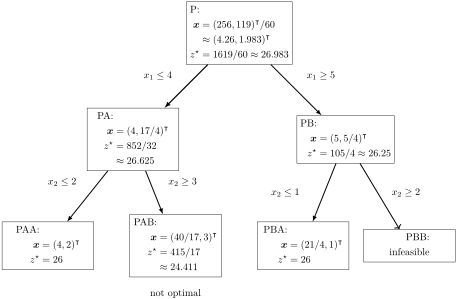
\(81\text{.}\) Let’s see where we stand with the following tree diagram.