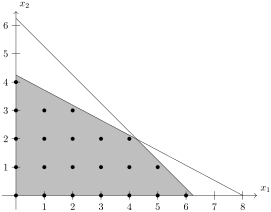
This problem is in standard maximum form so we can write down the tableau.
\begin{equation*}
\left[\begin{array}{rr|rrr|r} 17 \amp 32 \amp 1 \amp 0 \amp 0 \amp 136\\ 4 \amp 4 \amp 0 \amp 1 \amp 0 \amp 25\\ \hline -4 \amp -5 \amp 0 \amp 0 \amp 1 \amp 0\\ \end{array} \right]
\end{equation*}
Skipping some of the details, but using the simplex method, the next step is the tableau pivot
\(1 \mapsto 4\) (matrix pivot about row 2, column 1):
\begin{equation*}
1 \mapsto 4 \qquad \left[\begin{array}{rr|rrr|r} 0 \amp 60 \amp 4 \amp -17 \amp 0 \amp 119\\ 4 \amp 4 \amp 0 \amp 1 \amp 0 \amp 25\\ \hline 0 \amp -4 \amp 0 \amp 4 \amp 4 \amp 100\\ \end{array} \right]
\end{equation*}
This is not optimal, so another pivot is done. The tableau pivot of
\(2 \mapsto 3\) or the matrix pivot of row 1, column 2 results in
\begin{equation*}
2 \mapsto 3 \qquad \left[\begin{array}{rr|rrr|r} 0 \amp 60 \amp 4 \amp -17 \amp 0 \amp 119\\ 60 \amp 0 \amp -4 \amp 32 \amp 0 \amp 256\\ \hline 0 \amp 0 \amp 4 \amp 43 \amp 60 \amp 1619\\ \end{array} \right]
\end{equation*}
this is now optimal with basic solution
\begin{equation*}
\boldsymbol{x} = \frac{1}{60} \left[\begin{array}{rr|rr} 256 \amp 119 \amp 0 \amp 0 \end{array}\right]
\end{equation*}
and this is clearly not an integer solution.