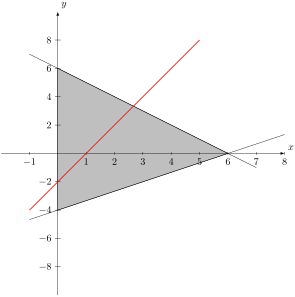
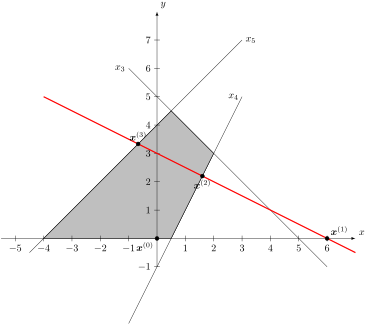
The first step is to write the problem in standard form, so the third constraint is written as
\(-x_1+x_2 \leq 4\) and the objective function is written as
\(z = -5x_1-x_2\) then the simplex tableau can be
\begin{align*}
\amp\begin{array}{rrrrrr}\amp \phantom{1} F \end{array}\\
\amp\left[\begin{array}{rr|rrrr|r} 1 \amp 1 \amp 1 \amp 0 \amp 0 \amp 0 \amp 5\\ 2 \amp -1 \amp 0 \amp 1 \amp 0 \amp 0 \amp 1\\ -1 \amp 1 \amp 0 \amp 0 \amp 1 \amp 0 \amp 4\\ 1 \amp 2 \amp 0 \amp 0 \amp 0 \amp 0 \amp 6\\ \hline 5 \amp 1 \amp 0 \amp 0 \amp 0 \amp 1 \amp 0\\ \end{array} \right]
\end{align*}
Since
\(x_1\) is a free variable, but is not in the basis, Phase 0 needs to be performed with
\begin{align*}
\amp\begin{array}{rrrrrr}\phantom{11} F \end{array}\\
1 \mapsto \emptyset, \qquad \amp \left[\begin{array}{rr|rrrr|r} 0 \amp -1 \amp 1 \amp 0 \amp 0 \amp 0 \amp -1\\ 0 \amp -5 \amp 0 \amp 1 \amp 0 \amp 0 \amp -11\\ 1 \amp 2 \amp 0 \amp 0 \amp 0 \amp 0 \amp 6\\ 0 \amp 3 \amp 0 \amp 0 \amp 1 \amp 0 \amp 10\\ \hline 0 \amp -9 \amp 0 \amp 0 \amp 0 \amp 1 \amp -30\\ \end{array} \right]
\end{align*}
This is not feasible, so we are in Phase I. The following steps will create a feasible tableau:
\begin{align*}
\amp\begin{array}{rrrrrr}\phantom{11} F \end{array}\\
\begin{array}{r} 2 \mapsto 4, \end{array} \qquad \amp \left[\begin{array}{rr|rrrr|r} 0 \amp 0 \amp 5 \amp -1 \amp 0 \amp 0 \amp 6\\ 0 \amp 5 \amp 0 \amp -1 \amp 0 \amp 0 \amp 11\\ 0 \amp 0 \amp 0 \amp 3 \amp 5 \amp 0 \amp 17\\ 5 \amp 0 \amp 0 \amp 2 \amp 0 \amp 0 \amp 8\\ \hline 0 \amp 0 \amp 0 \amp -9 \amp 0 \amp 5 \amp -51\\ \end{array} \right]
\end{align*}
And this is feasible now, however it is not optimal, so continue with Phase II. If we find
\(\boldsymbol{b}\)-ratios with the 4th column, we get
\begin{equation*}
\begin{bmatrix} 6/(-1) \\ 11/(-1) \\ 17/3 \\ 8/2 \end{bmatrix} \approx \begin{bmatrix} -6 \\ -11 \\ 5.67 \\ 4 \end{bmatrix}
\end{equation*}
Normally, we would choose the 4th row because it is the smallest nonnegative ratio, however, this corresponds to
\(x_1\) which is a free variable and cannot remove it from the basis. Therefore we will choose the 3rd row, corresponding to
\(x_5\) to leave the basis.
\begin{align*}
\amp\begin{array}{rrrrrr}\phantom{11} F \end{array}\\
4 \mapsto 5, \qquad \amp\left[\begin{array}{rr|rrrr|r} 0 \amp 0 \amp 3 \amp 0 \amp 1 \amp 0 \amp 7\\ 0 \amp 3 \amp 0 \amp 0 \amp 1 \amp 0 \amp 10\\ 0 \amp 0 \amp 0 \amp 3 \amp 5 \amp 0 \amp 17\\ 3 \amp 0 \amp 0 \amp 0 \amp -2 \amp 0 \amp -2\\ \hline 0 \amp 0 \amp 0 \amp 0 \amp 9 \amp 3 \amp 0\\ \end{array} \right]
\end{align*}
and this solution is now optimal with the basic solution
\begin{equation*}
\boldsymbol{x} = \frac{1}{3} \left[\begin{array}{rr|rrrr} -2 \amp 10 \amp 7 \amp 17 \amp 0\end{array}\right].
\end{equation*}
and recall that since
\(x_1\) is a free variable, it can take on any value, so the negative number is not a problem.