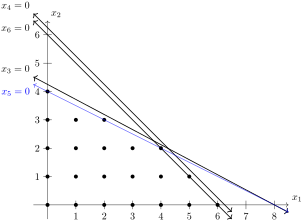
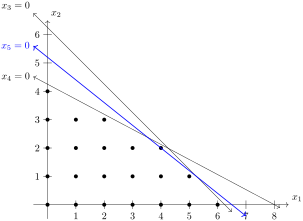
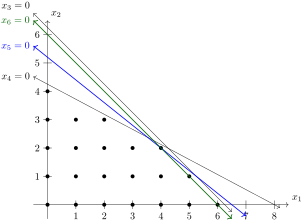
First set up the initial tableau:
\begin{equation*}
\left[\begin{array}{rrr|rrrr|r} 1 \amp 7 \amp 3 \amp 1 \amp 0 \amp 0 \amp 0 \amp 53\\ 4 \amp 4 \amp 0 \amp 0 \amp 1 \amp 0 \amp 0 \amp 51\\ 8 \amp 0 \amp 4 \amp 0 \amp 0 \amp 1 \amp 0 \amp 65\\ \hline -3 \amp -6 \amp -5 \amp 0 \amp 0 \amp 0 \amp 1 \amp 0\\ \end{array} \right]
\end{equation*}
perform standard phase II pivots,
\(1 \mapsto 6, 2 \mapsto 5, 3 \mapsto 4, 5 \mapsto 1\)
\begin{equation*}
\left[\begin{array}{rrr|rrrr|r} 56 \amp 0 \amp 28 \amp 0 \amp 0 \amp 7 \amp 0 \amp 455\\ -20 \amp 28 \amp 0 \amp 4 \amp 0 \amp -3 \amp 0 \amp 17\\ 192 \amp 0 \amp 0 \amp -16 \amp 28 \amp 12 \amp 0 \amp 1360\\ \hline 76 \amp 0 \amp 0 \amp 24 \amp 0 \amp 17 \amp 28 \amp 2377\\ \end{array} \right]
\end{equation*}
THE REST OF THIS NEEDS TO BE REDONE!!!!!
To find a cutting plane, find the right column mod 28 and the largest one is in the 2nd row. We write down the equation:
\begin{equation*}
-20 x_1 + 28 x_2 + 4 x_4 - 3 x_6 = 17
\end{equation*}
The goal is now to make the left side a multiple of 28 (the slack variable coefficient) and to accomplish this, put parameters on the right side with coefficients that are negative and not less than
\(-28\text{.}\) This is done by adding/subtracting appropriate multiples of terms.
\begin{equation*}
\begin{aligned} -20x_1 - 8x_1 + 28 x_2 - 3x_6 -25 x_6 \amp = 17 - 8x_1 - 4x_4 - 25 x_6 \\ 28 (-x_1 + x_2 - x_6) \amp = 17 - 8x_1 - 4x_4 - 25 x_6 \end{aligned}
\end{equation*}
and the new constraint is the right hand side needs to be 0 at most or
\begin{equation*}
-8x_1 -4x_4 -25 x_6 \leq -17
\end{equation*}
Add a slack variable to this in the form
\(28x_7\) to this constraint:
\begin{equation*}
-8x_1 -4x_4 -25 x_6 +28 x_7 = -17
\end{equation*}
Add this to the tableau to get:
\begin{equation*}
\left[\begin{array}{rrr|rrrrr|r} 56 \amp 0 \amp 28 \amp 0 \amp 0 \amp 7 \amp 0 \amp 0 \amp 455\\ -20 \amp 28 \amp 0 \amp 4 \amp 0 \amp -3 \amp 0 \amp 0 \amp 17\\ 192 \amp 0 \amp 0 \amp -16 \amp 28 \amp 12 \amp 0 \amp 0 \amp 1360\\ -8 \amp 0 \amp 0 \amp -4 \amp 0 \amp -25 \amp 28 \amp 0 \amp -17\\ \hline 76 \amp 0 \amp 0 \amp 24 \amp 0 \amp 17 \amp 0 \amp 28 \amp 2377\\ \end{array} \right]
\end{equation*}
This is infeasible and the pivot
\(1 \mapsto 7\) makes it feasible. Then the follow phase II pivots solve this LOP:
\begin{equation*}
\begin{array}{r} 4 \mapsto 2, \\ 6 \mapsto 1, \\ 2 \mapsto 4 \end{array} \qquad \left[\begin{array}{rrr|rrrrr|r} 48 \amp 0 \amp 25 \amp -1 \amp 0 \amp 0 \amp 7 \amp 0 \amp 402\\ -17 \amp 25 \amp 0 \amp 4 \amp 0 \amp 0 \amp -3 \amp 0 \amp 17\\ 168 \amp 0 \amp 0 \amp -16 \amp 25 \amp 0 \amp 12 \amp 0 \amp 1207\\ 8 \amp 0 \amp 0 \amp 4 \amp 0 \amp 25 \amp -28 \amp 0 \amp 17\\ \hline 63 \amp 0 \amp 0 \amp 19 \amp 0 \amp 0 \amp 17 \amp 25 \amp 2112\\ \end{array} \right]
\end{equation*}
This is optimal, but is not integral, so perform another step of Gomory’s method. Take the right column mod 25 and the largest value is rows 2 or 4. Since we always break a tie with a smaller index, we’ll take row 2 and write down the equation:
\begin{equation*}
-17 x_1 + 25 x_2 + 4 x_4 - 3 x_7 = 17
\end{equation*}
And again, we manipulate this equation to get the left side to be a multiple of the slack variable coefficient (25) with the parameter coefficients negative.
\begin{equation*}
\begin{aligned} -17 x_1 -8x_1 + 25 x_2 - 3 x_7 -22x_7 = 17 - 8x_1 - 4x_4 - 22x_7 \\ 25(-x_1 + x_2 - x_7) \amp = 17 - 8 x_1 - 4 x_4 - 22 x_7 \end{aligned}
\end{equation*}
The new constraint is that the right hand side is bounded above by 0 or
\begin{equation*}
- 8 x_1 - 4 x_4 - 22 x_7\leq -17
\end{equation*}
which including a slack variable
\(25 x_8\) results in
\begin{equation*}
- 8 x_1 - 4 x_4 - 22 x_7 + 25x_8 = -17
\end{equation*}
resulting in the tableau:
\begin{equation*}
\left[\begin{array}{rrr|rrrrrr|r} 48 \amp 0 \amp 25 \amp -1 \amp 0 \amp 0 \amp 7 \amp 0 \amp 0 \amp 402\\ -17 \amp 25 \amp 0 \amp 4 \amp 0 \amp 0 \amp -3 \amp 0 \amp 0 \amp 17\\ 168 \amp 0 \amp 0 \amp -16 \amp 25 \amp 0 \amp 12 \amp 0 \amp 0 \amp 1207\\ 8 \amp 0 \amp 0 \amp 4 \amp 0 \amp 25 \amp -28 \amp 0 \amp 0 \amp 17\\ -8 \amp 0 \amp 0 \amp -4 \amp 0 \amp 0 \amp -22 \amp 25 \amp 0 \amp -17\\ \hline 63 \amp 0 \amp 0 \amp 19 \amp 0 \amp 0 \amp 17 \amp 0 \amp 25 \amp 2112\\ \end{array} \right]
\end{equation*}
The pivot
\(1 \mapsto 8\) will make this tableau feasible and then one gets the following phase II pivots and resulting tableau
\begin{equation*}
\begin{array}{r} 4 \mapsto 2, \\ 7 \mapsto 1, \\ 2 \mapsto 4, \end{array} \qquad \left[\begin{array}{rrr|rrrrrr|r} 40 \amp 0 \amp 22 \amp -2 \amp 0 \amp 0 \amp 0 \amp 7 \amp 0 \amp 349\\ -14 \amp 22 \amp 0 \amp 4 \amp 0 \amp 0 \amp 0 \amp -3 \amp 0 \amp 17\\ 144 \amp 0 \amp 0 \amp -16 \amp 22 \amp 0 \amp 0 \amp 12 \amp 0 \amp 1054\\ 16 \amp 0 \amp 0 \amp 8 \amp 0 \amp 22 \amp 0 \amp -28 \amp 0 \amp 34\\ 8 \amp 0 \amp 0 \amp 4 \amp 0 \amp 0 \amp 22 \amp -25 \amp 0 \amp 17\\ \hline 50 \amp 0 \amp 0 \amp 14 \amp 0 \amp 0 \amp 0 \amp 17 \amp 22 \amp 1847\\ \end{array} \right]
\end{equation*}
The basic solution of this tableau is not integral, so we perform another step. Take the right column mod 22 and the largest value is in the 3rd row. This row can be written as
\begin{equation*}
\begin{aligned} 144 x_1 -16x_4 + 22x_5 + 12 x_8 \amp = 1054 \\ 144 x_1 - 12x_1 - 16x_4 - 6x_4 + 22 x_5 - 47\cdot 22 \amp = 20 - 12x_1 - 6x_4 - 12 x_8 \\ 22 (6 x_1 - x_4 + x_5 - 47) \amp = 20 - 12x_1 - 6x_4 - 12 x_8 \end{aligned}
\end{equation*}
Again, the new constraint is that the left side needs to be bounded above by 0 or
\begin{equation*}
20 - 8x_1 - 6x_4 - 12 x_8 \leq 0.
\end{equation*}
Adding
\(-8x_1 - 6x_4 - 12 x_7 + 22x_{9} = -20 \) to the tableau results in
\begin{equation*}
\left[\begin{array}{rrr|rrrrrrr|r} 40 \amp 0 \amp 22 \amp -2 \amp 0 \amp 0 \amp 0 \amp 7 \amp 0 \amp 0 \amp 349\\ -14 \amp 22 \amp 0 \amp 4 \amp 0 \amp 0 \amp 0 \amp -3 \amp 0 \amp 0 \amp 17\\ 144 \amp 0 \amp 0 \amp -16 \amp 22 \amp 0 \amp 0 \amp 12 \amp 0 \amp 0 \amp 1054\\ 16 \amp 0 \amp 0 \amp 8 \amp 0 \amp 22 \amp 0 \amp -28 \amp 0 \amp 0 \amp 34\\ 8 \amp 0 \amp 0 \amp 4 \amp 0 \amp 0 \amp 22 \amp -25 \amp 0 \amp 0 \amp 17\\ -12 \amp 0 \amp 0 \amp -6 \amp 0 \amp 0 \amp -12 \amp 0 \amp 22 \amp 0 \amp -20\\ \hline 50 \amp 0 \amp 0 \amp 14 \amp 0 \amp 0 \amp 0 \amp 17 \amp 0 \amp 22 \amp 1847\\ \end{array} \right]
\end{equation*}
This is not feasible (as is true after every added constraint). First,
\(1 \mapsto 9\) will make the above feasible and then the following will give a optimal tableau:
\begin{equation*}
\begin{array}{r} 4 \mapsto 1, \\ 8 \mapsto 4, \end{array} \qquad \left[\begin{array}{rrr|rrrrrrr|r} 18 \amp 0 \amp 12 \amp -3 \amp 0 \amp 0 \amp 0 \amp 0 \amp 7 \amp 0 \amp 184\\ -6 \amp 12 \amp 0 \amp 3 \amp 0 \amp 0 \amp 0 \amp 0 \amp -3 \amp 0 \amp 12\\ 72 \amp 0 \amp 0 \amp -12 \amp 12 \amp 0 \amp 0 \amp 0 \amp 12 \amp 0 \amp 564\\ 24 \amp 0 \amp 0 \amp 12 \amp 0 \amp 12 \amp 0 \amp 0 \amp -28 \amp 0 \amp 44\\ 18 \amp 0 \amp 0 \amp 9 \amp 0 \amp 0 \amp 12 \amp 0 \amp -25 \amp 0 \amp 32\\ 12 \amp 0 \amp 0 \amp 6 \amp 0 \amp 0 \amp 0 \amp 12 \amp -22 \amp 0 \amp 20\\ \hline 18 \amp 0 \amp 0 \amp 3 \amp 0 \amp 0 \amp 0 \amp 0 \amp 17 \amp 12 \amp 992\\ \end{array} \right]
\end{equation*}
This tableau’s basic solution is not integral, so we add another constraint. In this case, take the right column mod 12 and find the largest. Rows 4, 5 and 6 all have the same value of 8, so we take row 4 and write down the equation:
\begin{equation*}
\begin{aligned} 24 x_1 + 12x_4 + 12 x_6 - 28 x_9 \amp 44 \\
24 x_1 + 12 x_4 + 12 x_6 - 28 x_9 - 8 x_9 - 36 \amp = 8 -8 x_9 \\
12 (2x_1 + x_4 + x_6 - 3x_9) \amp = 8 - 8 x_9 \end{aligned}
\end{equation*}
So we add the constraint:
\(8 - 8x_9 \leq 0\) or
\(- 8x_9 + 12x_{10} = -8\) to the tableau to get:
\begin{equation*}
\left[\begin{array}{rrr|rrrrrrrr|r} 18 \amp 0 \amp 12 \amp -3 \amp 0 \amp 0 \amp 0 \amp 0 \amp 7 \amp 0 \amp 0 \amp 184\\ -6 \amp 12 \amp 0 \amp 3 \amp 0 \amp 0 \amp 0 \amp 0 \amp -3 \amp 0 \amp 0 \amp 12\\ 72 \amp 0 \amp 0 \amp -12 \amp 12 \amp 0 \amp 0 \amp 0 \amp 12 \amp 0 \amp 0 \amp 564\\ 24 \amp 0 \amp 0 \amp 12 \amp 0 \amp 12 \amp 0 \amp 0 \amp -28 \amp 0 \amp 0 \amp 44\\ 18 \amp 0 \amp 0 \amp 9 \amp 0 \amp 0 \amp 12 \amp 0 \amp -25 \amp 0 \amp 0 \amp 32\\ 12 \amp 0 \amp 0 \amp 6 \amp 0 \amp 0 \amp 0 \amp 12 \amp -22 \amp 0 \amp 0 \amp 20\\ 0 \amp 0 \amp 0 \amp 0 \amp 0 \amp 0 \amp 0 \amp 0 \amp -8 \amp 12 \amp 0 \amp -8\\ \hline 18 \amp 0 \amp 0 \amp 3 \amp 0 \amp 0 \amp 0 \amp 0 \amp 17 \amp 0 \amp 12 \amp 992\\ \end{array} \right]
\end{equation*}
and then since this is in phase I, perform a pivot
\begin{equation*}
9 \mapsto 10, \qquad \left[\begin{array}{rrr|rrrrrrrr|r}
12 \amp 0 \amp 8 \amp -2 \amp 0 \amp 0 \amp 0 \amp 0 \amp 0 \amp 7 \amp 0 \amp 118\\
-4 \amp 8 \amp 0 \amp 2 \amp 0 \amp 0 \amp 0 \amp 0 \amp 0 \amp -3 \amp 0 \amp 10\\
48 \amp 0 \amp 0 \amp -8 \amp 8 \amp 0 \amp 0 \amp 0 \amp 0 \amp 12 \amp 0 \amp 368\\
16 \amp 0 \amp 0 \amp 8 \amp 0 \amp 8 \amp 0 \amp 0 \amp 0 \amp -28 \amp 0 \amp 48\\
12 \amp 0 \amp 0 \amp 6 \amp 0 \amp 0 \amp 8 \amp 0 \amp 0 \amp -25 \amp 0 \amp 38\\
8 \amp 0 \amp 0 \amp 4 \amp 0 \amp 0 \amp 0 \amp 8 \amp 0 \amp -22 \amp 0 \amp 28\\
0 \amp 0 \amp 0 \amp 0 \amp 0 \amp 0 \amp 0 \amp 0 \amp 8 \amp -12 \amp 0 \amp 8\\ \hline
12 \amp 0 \amp 0 \amp 2 \amp 0 \amp 0 \amp 0 \amp 0 \amp 0 \amp 17 \amp 8 \amp 650\\
\end{array} \right]
\end{equation*}
This is optimal, but this is still not integral. Let’s try another step. Finding the last column modulo 8, the largest value is in rows 1 and 5. As is standard, with a tie, we’ll use the smaller indexed one or row 1, which can be written:
\begin{equation*}
\begin{aligned} 12 x_1 + 8 x_3 - 2x_4 + 7x_{10} \amp = 118 \\ 12 x_1 - 4x_1 + 8 x_3 -2x_4 - 6x_4 -112 \amp = 6 - 4x_1 - 6x_4 - 7x_{10} \\
8(x_1 + x_3 - x_4 - 14) \amp = 6 - 4x_1 - 6x_4 - 7x_{10} \end{aligned}
\end{equation*}
and the new constraint is that the right side is bounded above by 0, which is
\(6 - 4x_1 -6x_4-7x_{10} \leq 0\) which can be written with a slack variable as
\(-4x_1-6x_4-7x_{11} + 8x_{12} = -6\text{.}\) Adding this to the tableau is
\begin{equation*}
\left[\begin{array}{rrr|rrrrrrrrr|r}
12 \amp 0 \amp 8 \amp -2 \amp 0 \amp 0 \amp 0 \amp 0 \amp 0 \amp 7 \amp 0 \amp 0 \amp 118\\
-4 \amp 8 \amp 0 \amp 2 \amp 0 \amp 0 \amp 0 \amp 0 \amp 0 \amp -3 \amp 0 \amp 0 \amp 10\\
48 \amp 0 \amp 0 \amp -8 \amp 8 \amp 0 \amp 0 \amp 0 \amp 0 \amp 12 \amp 0 \amp 0 \amp 368\\
16 \amp 0 \amp 0 \amp 8 \amp 0 \amp 8 \amp 0 \amp 0 \amp 0 \amp -28 \amp 0 \amp 0 \amp 48\\
12 \amp 0 \amp 0 \amp 6 \amp 0 \amp 0 \amp 8 \amp 0 \amp 0 \amp -25 \amp 0 \amp 0 \amp 38\\
8 \amp 0 \amp 0 \amp 4 \amp 0 \amp 0 \amp 0 \amp 8 \amp 0 \amp -22 \amp 0 \amp 0 \amp 28\\
0 \amp 0 \amp 0 \amp 0 \amp 0 \amp 0 \amp 0 \amp 0 \amp 8 \amp -12 \amp 0 \amp 0 \amp 8\\
-4 \amp 0 \amp 0 \amp -6 \amp 0 \amp 0 \amp 0 \amp 0 \amp 0 \amp -7 \amp 8 \amp 0 \amp -6\\ \hline
12 \amp 0 \amp 0 \amp 2 \amp 0 \amp 0 \amp 0 \amp 0 \amp 0 \amp 17 \amp 0 \amp 8 \amp 650\\
\end{array} \right]
\end{equation*}
Note that the last row is not feasible, so perform a pivot to make it feasible:
\begin{equation*}
1 \mapsto 11 \left[\begin{array}{rrr|rrrrrrrrr|r}
0 \amp 0 \amp 4 \amp -10 \amp 0 \amp 0 \amp 0 \amp 0 \amp 0 \amp -7 \amp 12 \amp 0 \amp 50\\
0 \amp 4 \amp 0 \amp 4 \amp 0 \amp 0 \amp 0 \amp 0 \amp 0 \amp 2 \amp -4 \amp 0 \amp 8\\
0 \amp 0 \amp 0 \amp -40 \amp 4 \amp 0 \amp 0 \amp 0 \amp 0 \amp -36 \amp 48 \amp 0 \amp 148\\
0 \amp 0 \amp 0 \amp -8 \amp 0 \amp 4 \amp 0 \amp 0 \amp 0 \amp -28 \amp 16 \amp 0 \amp 12\\
0 \amp 0 \amp 0 \amp -6 \amp 0 \amp 0 \amp 4 \amp 0 \amp 0 \amp -23 \amp 12 \amp 0 \amp 10\\
0 \amp 0 \amp 0 \amp -4 \amp 0 \amp 0 \amp 0 \amp 4 \amp 0 \amp -18 \amp 8 \amp 0 \amp 8\\
0 \amp 0 \amp 0 \amp 0 \amp 0 \amp 0 \amp 0 \amp 0 \amp 4 \amp -6 \amp 0 \amp 0 \amp 4\\
4 \amp 0 \amp 0 \amp 6 \amp 0 \amp 0 \amp 0 \amp 0 \amp 0 \amp 7 \amp -8 \amp 0 \amp 6\\ \hline
0 \amp 0 \amp 0 \amp -8 \amp 0 \amp 0 \amp 0 \amp 0 \amp 0 \amp -2 \amp 12 \amp 4 \amp 316\\
\end{array} \right]
\end{equation*}
And then the following phase II pivots result in the optimal tableau:
\begin{equation*}
4 \mapsto 1 \left[\begin{array}{rrr|rrrrrrrrr|r}
10 \amp 0 \amp 6 \amp 0 \amp 0 \amp 0 \amp 0 \amp 0 \amp 0 \amp 7 \amp -2 \amp 0 \amp 90\\
-4 \amp 6 \amp 0 \amp 0 \amp 0 \amp 0 \amp 0 \amp 0 \amp 0 \amp -4 \amp 2 \amp 0 \amp 6\\
40 \amp 0 \amp 0 \amp 0 \amp 6 \amp 0 \amp 0 \amp 0 \amp 0 \amp 16 \amp -8 \amp 0 \amp 282\\
8 \amp 0 \amp 0 \amp 0 \amp 0 \amp 6 \amp 0 \amp 0 \amp 0 \amp -28 \amp 8 \amp 0 \amp 30\\
6 \amp 0 \amp 0 \amp 0 \amp 0 \amp 0 \amp 6 \amp 0 \amp 0 \amp -24 \amp 6 \amp 0 \amp 24\\
4 \amp 0 \amp 0 \amp 0 \amp 0 \amp 0 \amp 0 \amp 6 \amp 0 \amp -20 \amp 4 \amp 0 \amp 18\\
0 \amp 0 \amp 0 \amp 0 \amp 0 \amp 0 \amp 0 \amp 0 \amp 6 \amp -9 \amp 0 \amp 0 \amp 6\\
4 \amp 0 \amp 0 \amp 6 \amp 0 \amp 0 \amp 0 \amp 0 \amp 0 \amp 7 \amp -8 \amp 0 \amp 6\\ \hline
8 \amp 0 \amp 0 \amp 0 \amp 0 \amp 0 \amp 0 \amp 0 \amp 0 \amp 11 \amp 2 \amp 6 \amp 486\\
\end{array} \right]
\end{equation*}
results in an optimal and integral tableau. The basic variable for this is
\begin{equation*}
\begin{aligned} \boldsymbol{x} \amp = \frac{1}{6} \left[\begin{array}{rrr|rrrrrrrrrrr} 0 \amp 6 \amp 90 \amp 6 \amp 282 \amp 30 \amp 24 \amp 18 \amp 6 \amp 0 \amp 0 \end{array}\right] \\ \amp = \left[\begin{array}{rrr|rrrrrrrrrrr} 0 \amp 1 \amp 15 \amp 1 \amp 47 \amp 5 \amp 4 \amp 3 \amp 1 \amp 0 \amp 0 \end{array}\right] \end{aligned}
\end{equation*}
and in the original variables,
\(x_1 = 0, x_2 = 1\) and
\(x_3=15\text{.}\) The objective value is 81.