Skip to main content
Contents Dark Mode Prev Up Next \(\newcommand{\N}{\mathbb N}
\newcommand{\Z}{\mathbb Z}
\newcommand{\Q}{\mathbb Q}
\newcommand{\R}{\mathbb R}
\newcommand{\bu}{\boldsymbol{u}}
\newcommand{\bv}{\boldsymbol{v}}
\newcommand{\bw}{\boldsymbol{w}}
\newcommand{\bzero}{\boldsymbol{0}}
\DeclareMathOperator{\rad}{rad}
\DeclareMathOperator{\midpt}{midpt}
\DeclareMathOperator{\diam}{diam}
\DeclareMathOperator{\mig}{mig}
\DeclareMathOperator{\magn}{mag}
\DeclareMathOperator{\abs}{abs}
\newcommand{\lt}{<}
\newcommand{\gt}{>}
\newcommand{\amp}{&}
\definecolor{fillinmathshade}{gray}{0.9}
\newcommand{\fillinmath}[1]{\mathchoice{\colorbox{fillinmathshade}{$\displaystyle \phantom{\,#1\,}$}}{\colorbox{fillinmathshade}{$\textstyle \phantom{\,#1\,}$}}{\colorbox{fillinmathshade}{$\scriptstyle \phantom{\,#1\,}$}}{\colorbox{fillinmathshade}{$\scriptscriptstyle\phantom{\,#1\,}$}}}
\)
Section 8.2 An Abstract Look at Intervals
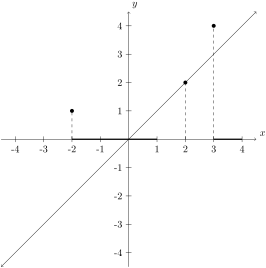
First, we can consider an interval in geometric terms as the point
\((\underline{a},\overline{a})\) in
\(\R^{2}\text{.}\) Some examples are:
Figure 8.2.1. And since for intervals
\(\underline{a}\leq \overline{a}\text{,}\) then all intervals can be represented as points on or above the line
\(y=x\text{.}\) All thin intervals are on the line
\(y=x\text{.}\)
Note also, that if we think of intervals in this way that addition is the same as vector addition. That is, as an example
\begin{equation*}
[3,4] + [-2,1] = [1,5]
\end{equation*}
Question: Is the set of all intervals with addition and scalar multiplication defined as ??? a vector space?