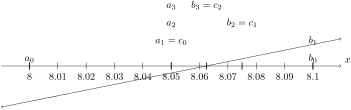
The length of the interval \(\ell_{n} = b_{n}-a_{n}\) is halved in each step. That is
\begin{equation*}
b_{n} - a_{n} = \frac{1}{2}(b_{n-1}-a_{n-1}) = \frac{1}{4}(b_{n-2}-a_{n-2}) = \cdots \frac{1}{2^{n}}(b_{0}-a_{0})
\end{equation*}
Since both \(p\) and \(p_{n}\) are in the interval \([a_{n},b_{n}]\text{,}\) thus
\begin{equation*}
|p-p_{n}| \leq b_{n} - a_{n} = \frac{1}{2^{n}}(b_{0}-a_{0}) = \frac{b-a}{2^{n}}
\end{equation*}
\begin{equation*}
\begin{aligned}\lim_{n \rightarrow \infty}|p - p_{n}| = \lim_{n \rightarrow \infty}\frac{1}{2^{n}}(b-a) = 0\end{aligned}
\end{equation*}
so the sequence \(\{ p_{n} \}\) converges to \(p\text{.}\)