Section 1.1 Polynomials

Recall that a polynomial is a function of the form:
\begin{equation*} P(x) = \sum_{k=0}^{n} a_{k} x^{k} \end{equation*}
where \(a_{k}\) are constants and \(a_{n} \neq 0\) is called the leading coefficient. The degree of the polynomial is \(n\text{.}\) Polynomials are quite important in numerical analysis.

Example 1.1.1.

  • Examples of polynomials include \(5, 3x-1, 3x^{2}+ 9x^{4}\text{.}\)
  • Functions that are not polynomials: \(\sqrt{x},\frac{x-1}{3x^{2}+1}, \sin x, e^{x}\text{.}\)
The polynomials with small degrees are generally called more specific names. Here are the polynomials of degrees with 0, 1, 2 and 3.
degree form type
0 \(f(x) = a_{0}\) horizontal line
1 \(f(x) = a_{0} + a_{1} x\) general line
2 \(f(x) = a_{0} + a_{1} x + a_{2} x^{2}\) quadratic
3 \(f(x) = a_{0} + a_{1} x + a_{2} x^{2} + a_{3} x^{3}\) cubic

Subsection 1.1.1 Power Functions

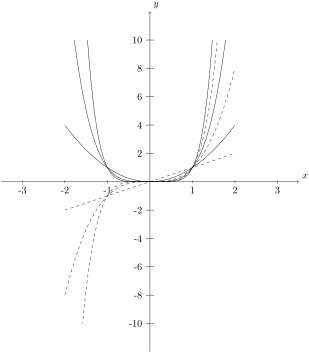
A power function has form \(f(x) = x^{n}\) for \(n\) a nonnegative integer. These functions are the building blocks of polynomials. The graph of \(f(x) = x^{n}\) for \(n=0,1,2,3,4,5,6\text{:}\)
Figure 1.1.2.
The 3 functions for \(n=2,4,6\) above are solid and shaped like cups opening up with the higher power growing faster with \(|x|>1\) a flatter bottom inside the interval \([-1,1]\text{.}\) The odd powers are dashed with a similar features in that the higher powers are steeper outside of the interval \([-1,1]\) and flatter inside the interval.

Subsection 1.1.2 Forms of Polynomials

Standard Form
\begin{equation} p(x) = a_{0} + a_{1} x + a_{2} x^{2} + \cdots + a_{n} x^{n}\tag{1.1.1} \end{equation}
This is a simple compact form of a polynomial and this can be useful for various types of theorems and it easy to see the degree and leading coefficient of the polynomial.
Factored Form:
The factored form of a polynomial can be written:
\begin{equation} p(x) = a(x-x_0)^{k_0} (x-x_1)^{k_1} \cdots (x-x_m)^{k_m}\tag{1.1.2} \end{equation}
where the roots are \(x_{0},x_{1},x_{m}\) and have multiplicity \(k_{0}, k_{1}, \ldots k_{m}\) respectively with \(a=a_{n}\) from the standard form above, called the leading coefficient and the multiplicities satisfy: \(n = k_{0}+k_{1} + \cdots + k_{m}\text{,}\) where \(n\) is the degree. Not all polynomials in standard form can be written in factored form, which assumes that all roots are real.
The factored form obviously gives you the roots directly, however, one can easily create a graph from this form as well. The behavior as \(|x| \rightarrow \infty\text{,}\) is the same as the power function with leading coefficient. That is it behaves like \(a_{n} x^{n}\text{.}\)
Additionally, the graph near each zero behaves like the multiplicity of zero. An example is given below in Example 1.1.3.
Horner’s Form
Lastly, if a polynomial is written in a nested form like
\begin{equation} p(x) = a_0 + x(a_1 + x (a_2 + x(a_3+ \cdots)))\tag{1.1.3} \end{equation}
it is in Horner’s Form, which is generally an efficient way of evaluating the polynomial at a point, both in terms of efficiency of operations and in terms of rounding errors as will be seen in Section 2.3.

Subsection 1.1.3 Graphs of Polynomials

The graph of a polynomial is most easily understood in factored form (1.1.2). The following can be determined directly from this form:
  • The \(x\)-intercepts are the roots of the polynomial, \(x_{0}, x_{1}, \ldots, x_{m}\text{.}\)
  • The multiplicity of the root \(x_i\) is denoted \(k_i\text{,}\) which is the power of the term \(x-x_i\) in the factored form. We will see in Section 3.1 an alternative way to find the multiplicity including the multiplicity of roots for functions other than polynomials.
  • The shape of the polynomial near \(x=x_{i}\) is \(b_{i}(x-x_{i})^{k_i}\text{,}\) where \(b_{i}=\lim_{x \rightarrow x_i}p(x)/(x-x_{i})^{k_i}\text{.}\)
  • The end behavior of the graph (shape of the curve for \(|x| \rightarrow \infty\)) is similar to the power function \(ax^{n}\text{,}\) where \(n\) is the degree and \(a\) is the leading coefficient.
  • The intervals of positive and negative values of the polynomial can be found by first understanding the sign of the power function \(ax^{n}\) for \(x>0\) and \(x<0\text{,}\) which depends on the sign of \(a\) and if \(n\) is even or odd. Once the sign of \(p\) is known for large \(x\) (in the positive or negative direction), we know that \(p\) will only switch sign over a zero with odd multiplicity.
The following few examples shows how to both manipulate polynomials as well as pull out the important information.

Example 1.1.3.

Consider the polynomial
\begin{equation} f(x) = 3x(x+1)(x-2)^{2}\text{.}\tag{1.1.4} \end{equation}
(a)
List all real zeros of the polynomial and the multiplicity of each.
Solution.
The zeros are \(x=0\) (with multiplicity 1), \(x=-1\) (with multiplicity 1) and \(x=2\) (with multiplicity 2).
(b)
Determine the \(x\)-intercepts and if the cross or just touch at each.
Solution.
The \(x\)-intercepts cross at \(x=0,-1\) and just touch \(x=2\text{.}\)
(c)
Find the power function that the polynomial resembles for large \(|x|\text{.}\)
Solution.
The power function is \(y=3x^{4}\text{,}\) where the 3 arises from the coefficient in front of the terms in (1.1.4) amd the 4 is the degree of the polynomial, the sum of all of the multiplicities.
(d)
Find intervals where the graph is above and below the \(x\)-axis.
Solution.
Since the power function for large \(|x|\) is \(3x^{4}\text{,}\) left of \(-1\) and right of \(2\) the function is positive. Recalling that the polynomial changes sign over roots of odd multiplicity however doesn’t over even multiplicity, one gets the following sign chart:
Figure 1.1.4.
(e)
Determine the graph of \(f\) near each zero.
Solution.
The graph of \(p\) near each of the zeros will take on the form \(b_{i}(x-x_{i})^{k_i}\text{.}\)
At the root \(x_0 = -1\)
\begin{equation*} b_0 = \lim_{x \to -1} \frac{3x(x+1)(x-2)^2}{x+1} = -27 \end{equation*}
so the form will be \(y=-81(x+1)\)
At the root \(x_1 = 0\)
\begin{equation*} b_1 = \lim_{x \to 0} \frac{3x(x+1)(x-2)^2}{x} = 12 \end{equation*}
so the form will be \(y=4(x-0) = 4x\)
At the root \(x_2=2\)
\begin{equation*} b_2 = \lim_{x \to 2} \frac{3x(x+1)(x-2)^2}{(x-2)^2} = 18 \end{equation*}
so the form will be \(y=18(x-2)^2\)
(f)
With all given information, plot \(y=f(x)\) with the graphs in #5.
Solution.
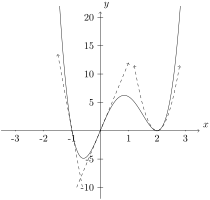
A graph of the polynomial and the three transformed power functions (as dashed curves):
Figure 1.1.5.
The next example shows use of these same concepts to construct the graph.

Example 1.1.6.

Construct the graph of the polynomial:
\begin{equation} p(x)= -\frac{1}{5}(x-2)^{3}(x+1)^{2}(x+3) \\\tag{1.1.5} \end{equation}
Solution.
This polynomial is in factored form. The roots are \(2, -1\) and \(-3\) with multiplicities 3, 2 and 1 respectively. Also, the degree of the polynomial is the sum of the multiplicities or 6. Notice that the term in front is \(-1/5\text{,}\) so the leading term is \(-\frac{1}{5}x^{6}\text{.}\)
The intervals on which the polynomial is positive and negative is found the following way. Note that the leading term is \(-\frac{1}{5}x^{6}\text{,}\) the far behavior of \(p\) is the same as this so it is negative for \(|x| \rightarrow \infty\text{.}\) The polynomial will change sign over the roots of odd multiplicity or at \(x=2\) and \(x=-3\text{.}\) Therefore the sign of the polynomial can be summarized in the following sign chart:
Figure 1.1.7. A graph of the sign chart of (1.1.5) .
The graph of \(p\) near each of the zeros will take on the form \(b_{i}(x-x_{i})^{k_i}\) or
When \(x=-3\)
\begin{equation*} b_1 = \lim_{x \rightarrow -3} \frac{p(x)}{(x+3)} = \lim_{x \rightarrow -3} -\frac{1}{5}(x-2)^3(x+1)^2 = 100 \end{equation*}
so near \(x=-3\text{,}\) the graph is \(100(x+3)\)
When \(x=-1\)
The multiplicity is 1 and the coefficient in front is
\begin{equation*} b_2 = \lim_{x \rightarrow -1} \frac{p(x)}{(x+1)^2} = \lim_{x \rightarrow -1} -\frac{1}{5}(x-2)^3(x+3) = \frac{54}{5} \end{equation*}
so near \(x=-1\text{,}\) the graph is \(\frac{54}{5}(x+1)^{2}\)
When \(x=2\)
The multiplicity is 2 and the coefficient in front is
\begin{equation*} b_3 = \lim_{x \rightarrow 2} \frac{p(x)}{(x-2)^3} = \lim_{x \rightarrow 2} -\frac{1}{5}(x+1)^2(x+3) = -9 \end{equation*}
so near \(x=2\text{,}\) the graph is m -\(-9(x-2)^{3}\text{.}\)
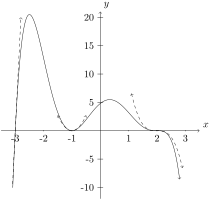
A graph of the polynomial and the three transformed power functions (as dashed curves):
Figure 1.1.8. A graph of the polynomial in (1.1.5) together with the power functions near each of the roots.
and one can see the similarity between the power functions and the polynomial near each of the roots.
Above the general form, factored form and Horner form of a polynomial was defined. The following example shows how to convert between these forms.

Example 1.1.9.

Find the standard form and Horner form of the polynomial \(p(x)=-\frac{1}{5}(x-2)^{3}(x+1)^{2}(x+3)\text{.}\)
The standard form is found by expanding all of the terms. This is a little painful, so a CAS like Matlab, Maple or Mathematica is often helpful.
\begin{equation*} p(x) = -\frac{1}{5}\,{x}^{6}+\frac{1}{5}\,{x}^{5}+{\frac{11\,{x}^{4}}{5}}-{\frac{13\,{x}^{3 }}{5}}-{\frac{26\,{x}^{2}}{5}}+4\,x+{\frac{24}{5}} \end{equation*}
To find the Horner form, we successive factor out an \(x\) in a nested way:
\begin{equation*} \begin{aligned} p(x)\amp= \biggl(-\frac{1}{5}\,{x}^{5}+\frac{1}{5}\,{x}^{4}+{\frac{11\,{x}^{3}}{5}}-{\frac{13\,{x}^{2 }}{5}}-{\frac{26\,{x}}{5}}+4\biggr)x+{\frac{24}{5}}\\\amp= \biggl(\biggl(-\frac{1}{5}\,{x}^{4}+\frac{1}{5}\,{x}^{3}+{\frac{11\,{x}^{2}}{5}}-{\frac{13\,{x}}{5}}-\frac{26}{5}\biggr)x+4\biggr)x+{\frac{24}{5}}\\\amp= \biggl(\biggl(\biggl(-\frac{1}{5}\,{x}^{3}+\frac{1}{5}\,{x}^{2}+{\frac{11\,x}{5}}-{\frac{13}{5}}\biggr) x-\frac{26}{5}\biggr)x+4\biggr)x+{\frac{24}{5}}\\\amp= \vdots \\\amp= \biggl(\biggl(\biggl(\biggl(\biggl(-\frac{1}{5}x+\frac{1}{5}\biggr)x+{\frac{11}{5}}\biggr)x-{\frac{13}{5}}\biggr) x-\frac{26}{5}\biggr)x+4\biggr)x+{\frac{24}{5}}\\ \end{aligned} \end{equation*}
As we will see later in ?????, the Horner form also decreases round off errors and shorten the number of operations needed to evaluate the polynomial.
Also as we will see in Section 6.4, some polynomials have properties that seem to be nice may not be so nice. For example a polynomial with equally spaced roots have a nice form, but the local extrema get very large. The following example is a polynomial with equally-spaced roots.

Example 1.1.10.

A Wilkinson polynomial is a polynomial of some degree \(n\) (an integer) with the following property: the polynomial as roots at \(1,2,3, \ldots, n\text{,}\) each of which has multiplicity 1. Write down the Wilkinson polynomial of degree 5.
Solution.
\begin{equation*} f(x) = (x-1)(x-2)(x-3)(x-4)(x-5) \end{equation*}
For the next example, we show how to find an polynomial function with properties such as roots and multiplicity.

Example 1.1.11.

Find a polynomial \(f(x)\) with the following roots and multiplicity:
Roots 1 -1 2
Multiplicity 2 1 3
and satisfies \(f(3)=-4\text{.}\)
Solution.
First, we write a general polynomial that satisfies the roots property with appropriate multiplicity:
\begin{equation*} f(x) = A(x-1)^{2}(x+1)(x-2)^{3} \end{equation*}
and then find \(A\) using \(f(3)=-4\text{,}\)
\begin{equation*} -4 = A(3-1)^{2}(3+1)(3-2)^{3} = 16A \end{equation*}
so \(A=-1/4\) and the polynomial is:
\begin{equation*} f(x) = -\frac{1}{4}(x-1)^{2}(x+1)(x-2)^{3} \end{equation*}
In Chapter 4, we will cover how to find a polynomial that passes through a given set of points. The next example is a fundamental building block of such polynomials called a Lagrange polynomial.

Example 1.1.12.

Find the simplest polynomial \(p(x)\) that has the property that \(p(x_{0})=1\text{,}\) \(p(x_{1})=0\) and \(p(x_{2})=0\text{.}\)
Since there are 3 points that it must satisfy, unless there is a special relationship between \(x_{0}, x_{1}\) and \(x_{2}\text{,}\) we will probably need a quadratic. We know two of the zeros of the polynomial, so a form is:
\begin{equation*} p(x) = A (x-x_{1})(x-x_{2}) \end{equation*}
and then we use the third point to find \(A\)
\begin{equation*} p(x_{0}) = 1 = A(x_{0}-x_{1})(x_{0}-x_{1}) \end{equation*}
or
\begin{equation*} A = \frac{1}{(x_{0}-x_{1})(x_{0}-x_{1})} \end{equation*}
therefore the polynomial is:
\begin{equation*} p(x) = \frac{(x-x_{1})(x-x_{2})}{(x_{0}-x_{1})(x_{0}-x_{1})} \end{equation*}

Subsection 1.1.4 Fundamental Theorem of Algebra

One of the most important analytical aspects of polynomials is the Fundamental Theorem of Algebra, which states that the number of roots of a polynomial equals the degree.
Although the statement is quite simple, the proof is not as it generally requires significant knowledge of Complex Analysis as is generally shown at the end of the course. See Complex Analysis by Howell and Mathews as a nice open-source text.
 1 
The proof is shown in Chapter 6 of that text.

Subsection 1.1.5 Quotient Remainder Theorem

Another important aspect of polynomials is that if there is division between two polynomials and this is often seen in polynomials long division. Consider the following example:
\begin{equation*} \begin{array}{r} x^2 - x - 1 \phantom{000000000000} \\ x^2 - 2x + 1 \enclose{longdiv}{x^4 - 3x^3 + 2x^2 + 4x - 1} \phantom{0} \\ \underline{-(x^4 - 2x^3 + x^2)} \phantom{000000000} \\ -x^3 + x^2 + 4x \phantom{00000} \\ \underline{-(-x^3 + 2x^2 - x)} \phantom{0000} \\ -x^2 + 5x - 1 \phantom{000} \\ \underline{-(-x^2 + 2x - 1)} \\ 3x \end{array} \end{equation*}
Recall that what this shows is that
\begin{equation*} x^4 - 3x^3 + 2x^2 + 4x - 1 = (x^2-x-1)(x^2-2x+1) + 3x \end{equation*}
and this can be done for various degrees of polynomials summarized in the following.
NOTE: FILL IN PROOF AND give some other examples how this helps.