Section 6.3 Orthogonal Polynomials and Least Squares Approximation

Let’s say that we have a function \(f(x)\) on an interval \([a,b]\text{.}\) We wish to find a polynomial \(P_{n}(x)\) that approximates \(f\) on the interval. A mathematical statement of this is that we wish to minimize
\begin{equation*} \begin{aligned}\int_{a}^{b} \bigl(f(x)-P_{n}(x))^{2} \,dx = ||f-P_{n}||_{2}\end{aligned} \end{equation*}
If we let \(P_{n}(x)\) be a general \(n\)th order polynomial, then
\begin{equation*} \begin{aligned}P_{n}(x)\amp = \sum_{k=0}^{n} a_{k} x^{k}\end{aligned} \end{equation*}
Then we wish to minimize
\begin{equation*} \begin{aligned}E(a_{0},a_{1},\ldots, a_{n})\amp = \int_{a}^{b} \biggl( f(x) - \sum_{k=0}^{n} a_{k} x^{k} \biggr)^{2} \, dx \\ \amp \qquad \text{which can be written as}\\ \amp = \int_{a}^{b} \bigl(f(x))^{2} \, dx - 2 \sum_{k=0}^{n} a_{k} \int_{a}^{b} x^{k} f(x) \, dx + \int_{a}^{b} \biggl( \sum_{k=0}^{n} a_{k} x^{k} \biggr)^{2} \, dx \\ \amp \qquad \text{and differentiating we obtain,}\\ \frac{\partial E}{\partial a_{j}}\amp = -2 \int_{a}^{b} x^{j} f(x) \, dx + 2 \sum_{k=0}^{n} a_{k} \int_{a}^{b} x^{j+k}\, dx.\end{aligned} \end{equation*}
and the minimum occurs when \(\partial E/\partial a_{k}=0\) for all \(k\) or
\begin{equation} \sum_{k=0}^{n} a_{k} \int_{a}^{b} x^{j+k}\, dx = \int_{a}^{b} x^{j} f(x) \, dx\tag{6.3.1} \end{equation}
These are called the normal equations. Since
\begin{equation} \int_{a}^{b} x^{j} \, dx = \frac{b^{j+1}-a^{j+1}}{j+1}\tag{6.3.2} \end{equation}
the normal equations in (6.3.1) form an \((n+1) \times (n+1)\) linear system in the unknown \(a\)’s. The elements of the matrix have the form in (6.3.2) and solving a system with such elements is numerically unstable due to rounding errors, thus finding the coefficients of the polynomial \(P_{n}(x)\) is not usually a desired way to go.
Despite this, we will show an interpolation using this form for \(f(x)=e^{x}\) on \([0,1]\) in the next example.

Example 6.3.1.

Use the normal equations in (6.3.1) to find \(P_{2}(x)\) that interpolates \(f(x)=e^{x}\) on \([0,1]\text{.}\)
Solution.
The equations form the linear equations:
\begin{equation*} \begin{aligned}a_{0} + \frac{1}{2}a_{1} + \frac{1}{3}a_{2}\amp = \int_{0}^{1} e^{x} \,dx = e-1\\ \frac{1}{2}a_{0} + \frac{1}{3}a_{1} + \frac{1}{4}a_{2}\amp = \int_{0}^{1} x e^{x} \, dx = 1\\ \frac{1}{3}a_{0} + \frac{1}{4}a_{1} + \frac{1}{5}a_{2}\amp = \int_{0}^{1} x^{2} e^{x} \, dx = e-2\\\end{aligned} \end{equation*}
the solution to this (using exact precision is),
\begin{equation*} \begin{aligned} a_{0}\amp = -105+39e,\amp a_{1}\amp = 588-216e,\amp a_{2}\amp = -570+210e. \end{aligned} \end{equation*}
A plot of this polynomial,
\begin{equation*} P_{2}(x) = -105+39e + (588-216e) x +(-570+210e) x^{2} \end{equation*}
and \(f(x)=e^{x}\) is
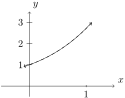
Figure 6.3.2.
The example above found the interpolating polynomial that minimizes \(||f-P_{2}||_{2}\text{,}\) however due to the form of the matrix, numerically, this is a poor way find the polynomial.
Instead, we will use orthogonal polynomials to construct the interpolating polynomial. This has many advantages.

Subsection 6.3.1 Orthogonal Polynomials

Proof.

Since \(\{\phi_{0},\phi_{1},\phi_{2}, \ldots, \phi_{n}\}\) is an orthogonal set of functions, then
\begin{equation*} \langle \phi_{i} , \phi_{j} \rangle = 0 \qquad \text{for all $i \neq j$.} \end{equation*}
Since
\begin{equation*} \begin{aligned}E\amp = ||f-P_{n}||_{w} = \biggl\vert\biggl\vert f(x) - \sum_{k=0}^{n} a_{k} \phi_{k}(x) \biggr\vert\biggr\vert \\\amp = \int_{a}^{b} w(x) \biggl( f(x) - \sum_{k=0}^{n} a_{k} \phi_{k}(x) \biggr)^{2} \, dx\end{aligned} \end{equation*}
setting \(\partial E /\partial a_{j}=0\) we get, the normal equations,
\begin{equation*} \frac{\partial E}{\partial a_{j}} = -2 \int_{a}^{b} w(x) f(x) \phi_{j} (x) \, dx + 2 \sum_{k=0}^{n} a_{k} \int_{a}^{b} w(x) \phi_{i}(x) \phi_{j}(x) \, dx \\ \end{equation*}
and since \(\int_{a}^{b} w(x) \phi_{j}\phi_{k} \, dx = 0\) if \(j \neq k\text{,}\) then solving for \(a_{j}\) results in
\begin{equation*} a_{j} = \frac{ \int_{a}^{b} f(x) w(x) \phi_{j} (x) \, dx}{\int_{a}^{b} w(x) \phi_{j}^{2} \, dx} \end{equation*}
This shows that if we have a set of orthogonal functions, then this theorem provides a way to find the polynomial that minimizes \(||f-P_{n}||_{w}\text{.}\) After the next section, we will show an example.

Subsection 6.3.2 The Gram-Schmidt process for Orthogonalizing Polynomials

As alluded to above, it is desirable to use orthogonal polynomials (with respect to some weight). The following is called the Gram-Schmidt process for doing this.
We saw the Legendre polynomials in Section 5.4 on Gaussian Quadrature and we now revisit them in a different context. The following example will show that the Legendre polynomials form an orthogonal set of functions with respect to \(w(x) \equiv 1\text{.}\)

Example 6.3.5.

Find the first 4 polynomials that are orthogonal with respect to the weight function \(w(x) \equiv 1\) on \([-1,1]\) using the Gram-Schmidt process.
Solution.
\begin{equation*} \begin{aligned}\phi_{0}\amp \equiv 1,\amp \phi_{1}\amp = x-B_{1}\end{aligned} \end{equation*}
where
\begin{equation*} B_{1} = \frac{\int_{-1}^{1} x(1)^{2} \, dx}{\int_{-1}^{1} (1)^{2} \, dx}= 0 \end{equation*}
so \(\phi_{1}=x\text{.}\) Also,
\begin{equation*} \begin{aligned} B_{2}\amp = \frac{\int_{-1}^{1} x^{3} \, dx}{\int_{-1}^{1} x^{2} \, dx}= 0\amp C_{2}\amp = \frac{\int_{-1}^{1} x^{2} \, dx}{\int_{-1}^{1}1 \, dx}= \frac{1}{3}\end{aligned} \end{equation*}
so
\begin{equation*} \begin{aligned}\phi_{2}\amp = (x-B_{2}) \phi_{1} - C_{2} \phi_{0} = (x-0)x - \frac{1}{3}\cdot 1 = x^{2} - \frac{1}{3}\end{aligned} \end{equation*}
and then
\begin{equation*} \begin{aligned}B_{3}\amp = \frac{\int_{-1}^{1} x (x^{2}-1/3)^{2} \, dx}{\int_{-1}^{1} (x^{2}-1/3)^{2} \, dx}= 0\amp C_{3}\amp = \frac{\int_{-1}^{1} x (x^{2}-1/3)x \, dx}{\int_{-1}{1}x^{2} \, dx}= \frac{4}{15}\end{aligned} \end{equation*}
so
\begin{equation*} \begin{aligned}\phi_{3}(x)\amp = (x-B_{3})\phi_{2} - C_{3}\phi_{1} = (x-0)(x^{2}-1/3)- \frac{4}{15}x = x^{3}- \frac{3}{5}x\end{aligned} \end{equation*}
Recall from Section 5.4 that the interpolation points for the 2-pt Gaussian Quadrature formula are the roots of \(\phi_{2}\) and that for the 3-pt formula was the roots of \(\phi_{3}\text{.}\)
And now that the Legendre Polynomials have been found, we will use them to do interpolation.

Example 6.3.6.

Use the set \(\{\phi_{0},\phi_{1},\phi_{2},\phi_{3}\}\) found above to find the interpolating polynomial \(P_{3}(x)\) that minimizes \(||f-P_{3}||\) with weight function \(w(x)\equiv 1\) where \(f(x) = \cos (\pi x/2)\text{.}\)
In this case, we will use Theorem 6.3.3 to find the coefficients of
\begin{equation*} P_{3}(x) = a_{0} \phi_{0} + a_{1} \phi_{1} + a_{2} \phi_{2} + a_{3} \phi_{3} \end{equation*}
where
\begin{equation*} \begin{aligned}a_{k}\amp = \frac{\int_{a}^{b} w(x) \phi_{k}(x) f(x) \, dx}{\int_{a}^{b} w(x) \bigl(\phi_{k}(x)\bigr)^{2} \, dx}\end{aligned} \end{equation*}
that is,
\begin{equation*} \begin{aligned}a_{0}\amp = \frac{\int_{-1}^{1} \cos (\pi x/2) \, dx }{\int_{-1}^{1} 1 \cdot (1)^{2} \, dx}= \frac{2}{\pi}\\ a_{1}\amp = \frac{\int_{-1}^{1} x \cos (\pi x/2) \, dx }{\int_{-1}^{1} 1 \cdot (x)^{2} \, dx}= 0 \\ a_{2}\amp = \frac{\int_{-1}^{1} (x^{2}-1/3) \cos (\pi x/2) \, dx }{\int_{-1}^{1} 1 \cdot (x^{2}-1/3)^{2} \, dx}= \frac{15(\pi^{2}-12)}{\pi^{3}}\\ a_{3}\amp = \frac{\int_{-1}^{1} (x^{3}-3x/5) \cos (\pi x/2) \, dx }{\int_{-1}^{1} 1 \cdot (x^{3}-3x/5)^{2} \, dx}= 0 \\\end{aligned} \end{equation*}
and the polynomial is
\begin{equation*} P_{3}(x) = \frac{2}{\pi}+ \frac{15(\pi^{2}-12)}{\pi^{3}}\biggl( x^{2}-\frac{1}{3}\biggr) \end{equation*}
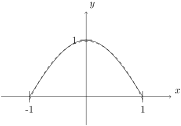
A good way to determine if the above function is correct to plot \(P_{3}(x)\) and \(\cos x\) together as the following shows:
Figure 6.3.7.
where the dashed curve is the polynomial. As one can see these are nearly identical as a plot.
The main purpose of this section is to show that there is a way to produce a set of orthogonal polynomials and then use them to produce a polynomial that minimizes a weighted norm. In the next section, we examine which norm may be the best.