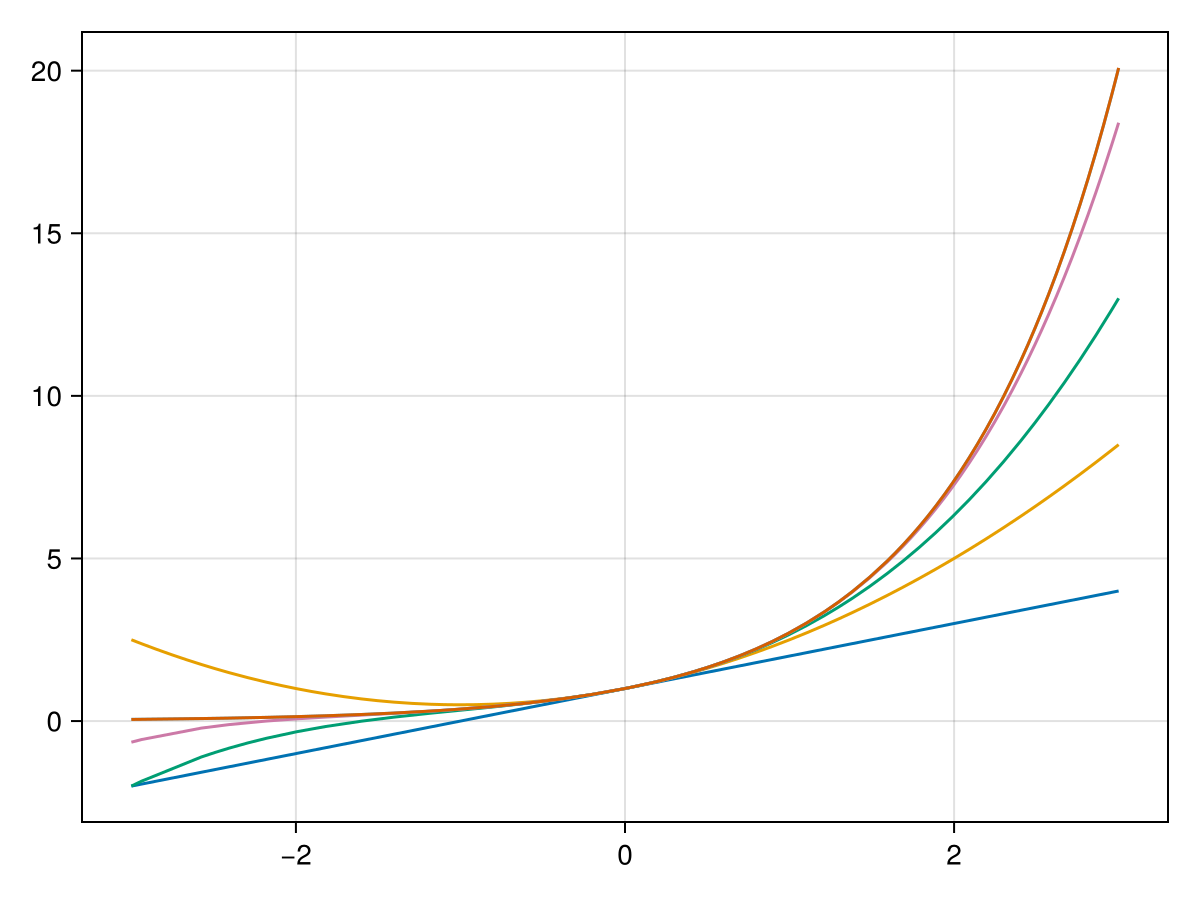
Since \(f(x)=e^{x}\text{,}\) recall that \(f^{(n)}(x) = e^{x}\) for all \(n\text{.}\) Let \(d\) be any positive number and for \(|x|\leq d\text{,}\) \(e^{x} \leq e^{d}\text{,}\) so \(M=e^{d}\text{.}\) Using Taylor’s Inequality,
\begin{equation*}
\begin{aligned}R_{n}(x)\amp \leq \frac{M}{(n+1)!}|x-a|^{n+1}= \frac{e^{d}}{(n+1)!}|x|^{n+1}\end{aligned}
\end{equation*}
Taking the limit as \(n \rightarrow \infty\)
\begin{equation*}
\begin{aligned}\lim_{n \rightarrow \infty}R_{n}(x) \leq \lim_{n \rightarrow \infty}\frac{e^{d}}{(n+1)!}|x|^{n+1}= 0\end{aligned}
\end{equation*}
by the theorem above, so since \(R_{n}(x) \rightarrow 0\) for all \(|x|\leq d\text{,}\) this proves that the Maclaurin series converges to \(e^{x}\) for all \(|x|\lt d\text{.}\) Since this is true for any number \(d\text{,}\) then this is true for any number \(x\text{.}\) \(\boxed{\phantom{x}}\)