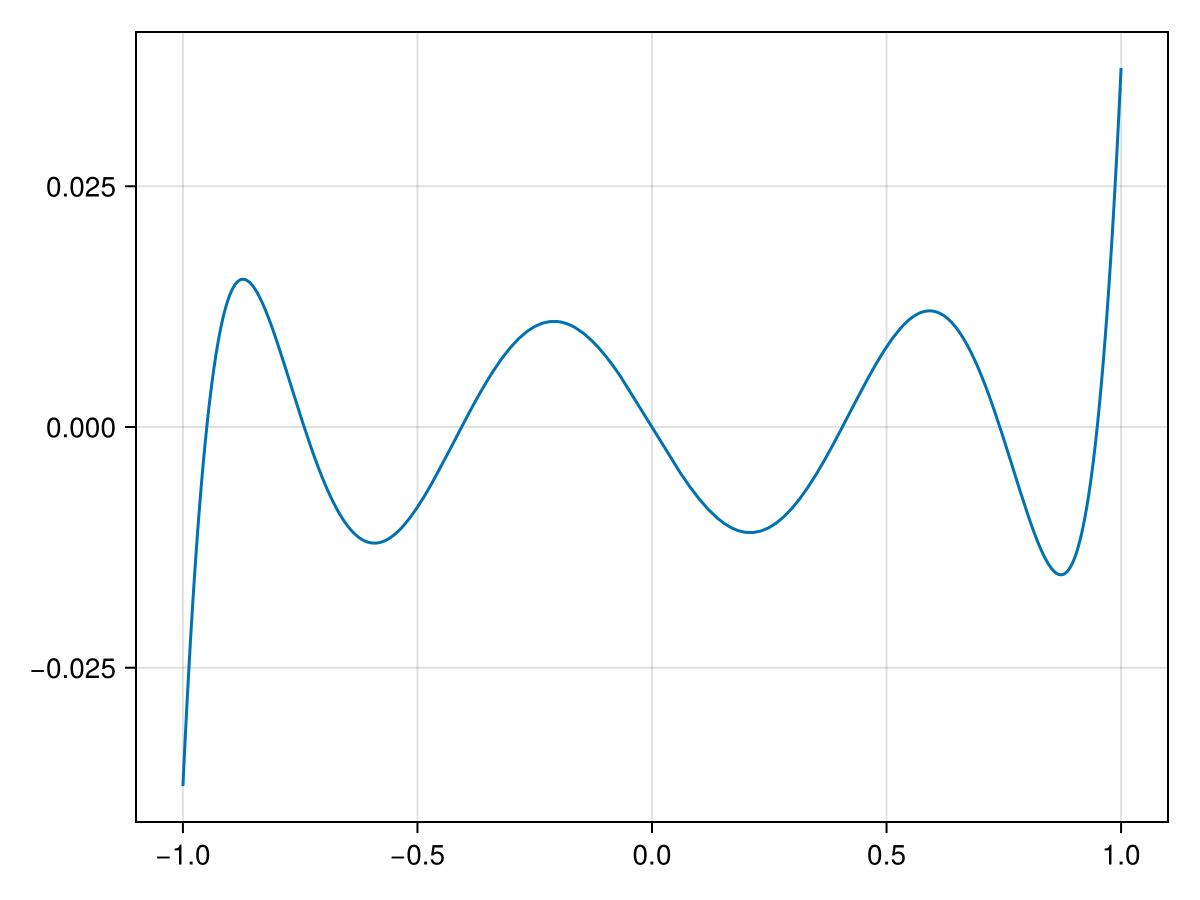
First, for the
\(n=2\) case, we need
\(P_2\text{,}\) which can be derived from
(6.5.1)
\begin{equation*}
P_2(x) = \frac{2(2)-1}{2} x P_1(x) - \frac{2-1}{2} P_0(x) = \frac{3}{2} x (x) - \frac{1}{2} (1) = \frac{3}{2}x^2-\frac{1}{2}
\end{equation*}
The nodes are the root of this or
\begin{equation*}
\begin{aligned} x^2 = \frac{1}{3} \qquad \Longrightarrow \quad x = \pm \frac{1}{\sqrt{3}} \end{aligned}
\end{equation*}
which is the same as the nodes found above. Next, we’ll find the weights.
First, we need the derivative so \(P'_2(x) = 3x\text{,}\) then
\begin{equation*}
w_0 = \frac{2}{(1-(1/3))(3(1/\sqrt{3}))^2} = 1
\end{equation*}
and similarly (mainly due to symmetry), \(w_1=1\text{.}\)
For the \(n=3\) case, we start with the 3rd Legendre Polynomial which can be derived as
\begin{equation*}
\begin{aligned} P_3(x) \amp = \frac{2(3)-1}{3} x P_2(x) - \frac{3-1}{3} P_1(x) \\ \amp = \frac{5}{3} x \left(\frac{3}{2}x^2-\frac{1}{2}\right) - \frac{2}{3} x \\ \amp = \frac{5}{2} x^3 -\frac{3}{2} x = \frac{1}{2} \left(5x^3-3x^2 \right) \end{aligned}
\end{equation*}
The quadrature nodes are the roots of this polynomial or
\begin{equation*}
x = 0, \pm \sqrt{\frac{3}{5}}.
\end{equation*}
To find the weights, we first need the derivative or
\begin{equation*}
P'_3 (x) = \frac{1}{2} \left(15 x^2 - 6\right)
\end{equation*}
and then
\begin{equation*}
\begin{aligned} w_0 \amp = \frac{2}{(1-(\sqrt{3/5})^2)((15(\sqrt{3/5})^2 -6)/2)^2} \\ \amp = \frac{2}{(2/5)(3)^2} = \frac{5}{9} \\ w_1 \amp = \frac{2}{(1-0^2)((-3/2)^2)} = \frac{8}{9} \\ w_2 \amp = w_0 = \frac{5}{9} \end{aligned}
\end{equation*}