
Section 1.4 Infinite Series

As we will see below, a power series is a function of \(x\text{,}\) however, recall the definition of the series as well as its convergence.

Definition 1.4.1.

The sum of the terms of a infinite sequence \((a_{1},a_{2},a_{3},\ldots)\) or
\begin{equation*} a_{1} + a_{2} + a_{3} + \cdots + a_{n} + \cdots \end{equation*}
is called an infinite series (or just a series) and is denoted
\begin{equation*} \sum_{n=1}^{\infty}a_{n} \qquad \text{or}\qquad \sum a_{n} \end{equation*}
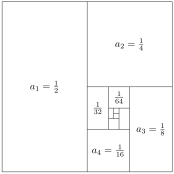
Why would we want to add up an infinite number of terms? Let’s answer this with the following picture.
Figure 1.4.2.
If we look at this as area, the total area is the area of the square or 1. If we look at this as a sum of the areas of rectangles, then the area is
\begin{equation*} \begin{aligned} s\amp= a_{1} + a_{2} + a_{3} + \cdots \\ \amp= \frac{1}{2}+ \frac{1}{4}+ \frac{1}{8}+ \cdots \end{aligned} \end{equation*}
And therefore this infinite sum is 1. This is an example of a geometric series which we will generalize below.

Subsection 1.4.1 Convergence of Series

The example above converged because the infinite sum was a value. We more formally define convergence by looking at a partial sum.

Definition 1.4.3.

For the series \(\sum a_{n}\text{,}\) define the \(n\)th partial sum, \(s_{n}\) as
\begin{equation*} s_{n} = \sum_{k=1}^{n} a_{n} = a_{1} + a_{2} + \cdots + a_{n}. \end{equation*}
If the sequence \(\{ s_{n}\}\) is convergent and \(s= \lim_{n\rightarrow \infty}s_{n}\text{,}\) then we write
\begin{equation*} \sum a_{n} = a_{1} + a_{2} + a_{3} + \cdots + a_{n} + \cdots = s \end{equation*}
and the number \(s\) is called the sum of the series.
If \(\lim_{n \rightarrow \infty}s_{n}\) does not converge, then we say the series diverges.
In summary, to determine if an infinite series converges, then
  1. Find the partial sum of the first \(n\) terms. Call this \(s_{n}\text{.}\)
  2. Determine if the sequence \(\{ s_{n} \}\) converges. Use the standard limit theorems to find this.

Example 1.4.4.

Show that
\begin{equation*} \sum_{n=1}^{\infty}\frac{1}{n(n+1)} \end{equation*}
converges and find the sum.
The way that you need to find this is to recall that you can use partial fractions to write:
\begin{equation*} \frac{1}{n(n+1)} = \frac{1}{n}- \frac{1}{n+1} \end{equation*}
therefore we can write:
\begin{equation*} \begin{aligned} \sum_{n=0}^{\infty}\frac{1}{n(n+1)}\amp= \sum_{n=0}^{\infty}\biggl( \frac{1}{n}- \frac{1}{n+1}\biggr) \\\amp= \biggl(1- \frac{1}{2}\biggr) + \biggl(\frac{1}{2}- \frac{1}{3}\biggr) + \biggl(\frac{1}{3}- \frac{1}{4}\biggr) + \cdots \end{aligned} \end{equation*}
and note that the partial sums are
\begin{equation*} \begin{aligned} s_{1}\amp= 1- \frac{1}{2}\\ s_{2}\amp= \biggl(1-\frac{1}{2}\biggr) + \biggl(\frac{1}{2}- \frac{1}{3}\biggr) = 1-\frac{1}{3}\\ s_{3}\amp= \biggl(1-\frac{1}{2}\biggr) + \biggl(\frac{1}{2}- \frac{1}{3}\biggr) + \biggl(\frac{1}{3}- \frac{1}{4}\biggr) = 1- \frac{1}{4}\\ \vdots\amp= \vdots \\ s_{k}\amp= 1- \frac{1}{k+1} \end{aligned} \end{equation*}
so the sum is
\begin{equation*} s = \lim_{n \rightarrow \infty}s_{k} = \lim_{n \rightarrow \infty}\biggl(1- \frac{1}{k+1}\biggr) = 1 \end{equation*}

Subsection 1.4.2 Geometric Series

Above we saw an example of a geometric series. We now generalize this.

Definition 1.4.5.

A geometric series is a series in the form:
\begin{equation*} s = a + ar + ar^{2} + \cdots ar^{k} + \cdots = \sum_{n=0}^{\infty}a r^{n-1} \end{equation*}
for real numbers \(a\) and \(r\text{.}\)
One nice aspect of a geometric series is that ratios of consecutive terms are constant. This means that:
\begin{equation*} \frac{a_{n+1}}{a_{n}} = \frac{a r^{n}}{ar^{n-1}}= r \end{equation*}
Below is an example that uses this fact to determine if a series is a geometric series. However, we have the following theorem to determine the convergence of a geometric series.

Proof.

The partial sums of the geometric series are
\begin{equation*} \begin{aligned} s_{1}\amp= a_{1} = a\\ s_{2}\amp= a_{1} + a_{2} =a + ar \\ s_{3}\amp= a_{1} + a_{2} + a_{3} =a + ar+ar^{2} \end{aligned} \end{equation*}
and the \(k\)th partial sum is
\begin{equation*} s_{k} = a_{1} + a_{2} + \cdots + a_{k} = c +cr + \cdots + cr^{k-1} \end{equation*}
If we multiply \(s_{k}\) by \(r\) we get:
\begin{equation*} \begin{aligned} rs_{k}\amp= r(a + ar + ar^{2} + \cdots ar^{k-1}) \\\amp=ar + ar^{2} + ar^{3} + \cdots ar^{k} \end{aligned} \end{equation*}
and subtracting \(rs_{k}\) from \(s_{k}\) we get:
\begin{equation*} \begin{aligned} s_{k} - rs_{k}\amp= \bigr(a + ar + ar^{2} + \cdots ar^{k-1}\bigr) - \bigl(ar + ar^{2} + ar^{3} + \cdots ar^{k}\bigr) \\\amp= a- ar^{k}. \end{aligned} \end{equation*}
Next, we solve for \(s_{k}\text{:}\)
\begin{equation*} \begin{aligned} s_{k} - rs_{k}\amp= c-cr^{k}\\ s_{k}(1-r)\amp= c-cr^{k}\\ s_{k}\amp= \frac{c-cr^{k}}{1-r} \end{aligned} \end{equation*}
Assume that \(|r| < 1\text{,}\) then taking the limit,
\begin{equation*} \begin{aligned} s\amp= \lim_{n \rightarrow \infty}s_{n} = \lim_{n \rightarrow \infty}\frac{c-cr^{n}}{1-r}\\\amp= \frac{c}{1-r}\lim_{n \rightarrow \infty}(1 - r^{n}) \\\amp= \frac{c}{1-r} \end{aligned} \end{equation*}
If \(|r| \gt 1\text{,}\) then
\begin{equation*} \lim_{n \rightarrow \infty}r^{n} \end{equation*}
does not exist, so this diverges. Lastly, we look at \(r=1\) and \(r=-1\text{.}\) In each case, we return to the series. If \(r=1\text{,}\)
\begin{equation*} \sum_{n=0}^{\infty}a r^{n} = a+a+a+a+ \cdots \end{equation*}
and this diverges. If \(r=-1\text{,}\) then
\begin{equation*} \sum_{n=0}^{\infty}a r^{n} = a-a+a-a+a-a \end{equation*}
which also diverges, so the theorem holds.
Example 1.4.7.

For each of the following, determine if you have a geometric series. If so, find \(r\) and \(c\text{.}\)
  1. \(\displaystyle \displaystyle \sum_{n=1}^{\infty}3 \biggl(\frac{2}{3}\biggr)^{n}\)
  2. \(\displaystyle \displaystyle \sum_{n=0}^{\infty}\frac{1}{n}\)
  3. \(\displaystyle \sum_{n=4}^{\infty}\frac{(-2)^{n}}{32}\text{.}\)
  4. \(\displaystyle \displaystyle 0.09090909\ldots = 0.\overline{09}\)
In each case above, we try to determine \(c\) and \(r\text{.}\) x
  1. Note that this fits the form of the geometric series with \(r=2/3\) and \(a=2\text{.}\) Since \(|r| \lt 1\text{,}\) then the series converges to
    \begin{equation*} s= \frac{a}{1-r}= \frac{2}{1-2/3}= 6. \end{equation*}
  2. In this case
    \begin{equation*} \frac{a_{n+1}}{a_{n}}= \frac{1/(n+1)}{1/n}= \frac{n}{n+1} \end{equation*}
    which is not a constant, so this is not geometric.
  3. In this case the term starts at \(n=4\text{,}\) however, \(a\) is still the first term in the series, or 1/2 and \(r=-2\text{,}\) so this is geometric. However, since \(|r| \gt 1\text{,}\) the series does not converge.
  4. This doesn’t appear to be a geometric series. However if we write it as:
    \begin{equation*} \begin{aligned} s\amp= 0.09 + 0.0009 + 0.000009 + \cdots \\\amp= \frac{9}{100}+ \frac{9}{(100)^{2}}+ \frac{9}{(100)^{3}}+ \cdots \end{aligned} \end{equation*}
    and note that
    \begin{equation*} \frac{a_{n+1}}{a_{n}} = \frac{\frac{9}{(100)^{n+1}}}{\frac{9}{(100)^{n}}}= \frac{1}{100} \end{equation*}
    and since this is constant it is a geometric series with \(r=1/100\) and since this satisfies \(|r| \lt 1\text{,}\) the series converges. The first term is \(a=9/100\) and thus the series converges to
    \begin{equation*} \frac{a}{1-r}= \frac{9/100}{1-1/100}= \frac{9/100}{99/100}= \frac{9}{99}= \frac{1}{11} \end{equation*}
This technique works to find the rational number version of any repeated decimal, which can always be written as a geometric series.

Subsection 1.4.3 Tests for Convergence of Series

The convergence of a series is a very important concept. Without going over all of tests for series, we refer again to APEX Calculus, specifically Chapter 8. We cover a few tests here:

Example 1.4.10.

Determine if the following series converge?
  1. \(\displaystyle \displaystyle \sum_{n=1}^{\infty}\frac{(-1)^{n}}{n}\)
  2. \(\displaystyle \displaystyle \sum_{n=1}^{\infty}(-1)^{n} \frac{n}{(n+1)^{2}}\)
  1. In the first case \(b_{n} = 1/n\text{.}\) Thus \(b_{n}\) is positive and decreasing. Also, since
    \begin{equation*} \lim_{n \rightarrow \infty}b_{n} = 0 \end{equation*}
    Then the series converges.
  2. In this case \(b_{n} = n/(n+1)^{2}\text{.}\) Again, this is a positive series. To show that \(b_{n+1}\leq b_{n}\text{,}\) it’s easier to show that \(b_{n} = f(n)\) and \(f'(x) \lt 0\text{.}\)
    \begin{equation*} \begin{aligned} f(x)\amp= x(x+1)^{-2}\\ f'(x)\amp= (x+1)^{-2}- 2x (x+1)^{-3}= \frac{(x+1) -2x}{(x+1)^{3}}\\\amp= \frac{1-x}{(x+1)^{3}} \end{aligned} \end{equation*}
    which is negative for all \(x \gt 1\text{,}\) so it is a decreasing function. Also,
    \begin{equation*} \lim_{n \rightarrow \infty}\frac{n}{(n+1)^{2}}= 0 \end{equation*}
    so the series converges by the AST.
One of the most robust tests, however, is covered here:

Proof.

Consider the case when \(L \lt 1\text{.}\) We will compare the series to a geometric series with \(L \lt r \lt 1\text{.}\) Since
\begin{equation*} \lim_{n \rightarrow \infty}\biggl\vert \frac{a_{n+1}}{a_{n}}\biggr\vert =L \end{equation*}
converges, then eventually \(|a_{n+1}/a_{n}|\) will be less than \(r\) and let’s say that this occurs at \(N\text{,}\) specifically:
\begin{equation*} \biggl\vert \frac{a_{n+1}}{a_{n}}\biggr\vert \lt r \qquad \text{for all $n\geq N$.} \end{equation*}
This results in
\begin{equation*} \begin{aligned} |a_{N+1}|\amp \lt |N_{n}| r \\ |a_{N+2}|\amp \lt |a_{N+1}| r \lt |a_{N}| r^{2} \\ \vdots\amp\\ |a_{N+k}|\amp \lt |a_{N}| r^{k} \end{aligned} \end{equation*}
for all \(k\geq 1\) an
Recall that we want to show that the series \(\sum a_{n}\) converges absolutely, which means that \(\sum |a_{n}|\) converges.
\begin{equation*} \begin{aligned} \sum_{n=0}^{\infty}|a_{n}|\amp= \sum_{n=1}^{N-1}|a_{n}| + \sum_{n=N}^{\infty}|a_{n}| \\\amp \lt \sum_{n=1}^{N-1}|a_{n}| +\sum_{n=N}^{\infty}|a_{N}| r^{n} \end{aligned} \end{equation*}
and since the second series is geometric with \(r \lt 1\text{,}\) it converges, therefore, \(\sum |a_{n}|\) converges and that means that \(\sum a_{n}\) converges. Similar techniques can be used to show the results if \(L \gt 1\text{.}\)
The next example shows how to apply the Ratio Test.

Example 1.4.12.

Use Theorem 1.4.11 to determine if the following converge or diverge, if the theorem applies.
(a)
\begin{equation*} \sum_{n=1}^{\infty} \frac{n}{2^n (n-1)!} \end{equation*}
(b)
\begin{equation*} \sum_{n=1}^{\infty} \frac{2^n}{n^3} \end{equation*}

