
Section 6.6 Rational Interpolation and Approximation

We now extend some of the ideas above to that using rational functions instead of polynomials.

Subsection 6.6.1 Padé Approximations

The first Rational Approximation to a function that we will discuss is that of the Padé approximation. This is the equivalent of the Taylor Series to rational functions.
Recall that a Taylor approximation to a function \(f(x)\) is a polynomial \(P(x)\) such that
\begin{equation*} \begin{aligned}f^{(i)}(x_{0})\amp = P^{(i)}(x_{0}) \qquad \text{for some $x_{0}$ and $i=0,1, \ldots, n$}\end{aligned} \end{equation*}

Example 6.6.1.

The Taylor Polynomial \(P_{2}(x)\) to \(f(x)=e^{-x}\) at \(x_{0}=0\) is
\begin{equation*} \begin{aligned}P_{2}(x)\amp = 1 - x + \frac{x^{2}}{2}\end{aligned} \end{equation*}
In a similar manner, let
\begin{equation*} \begin{aligned}R_{m,n}(x)\amp = \frac{\sum_{i=0}^{m} a_{i} x^{i}}{\sum_{i=0}^{n} b_{i} x_{i}}\end{aligned} \end{equation*}
where generally \(b_{0}=1\text{.}\) The Padé approximation \(R_{m,n}(x)\) is the rational function that satisfies:
\begin{equation*} \begin{aligned}f^{(i)}(x_{0})\amp = R^{(i)}_{m,n}(x)\end{aligned} \end{equation*}
for \(i=0,1,2, \ldots m+n\text{.}\)

Example 6.6.2.

Find the Padé approximation, \(R_{1,1}(x)\) to \(f(x)=e^{-x}\) at \(x_{0}=0\text{.}\)
Solution.
The function \(R_{1,1}(x)\) can be written:
\begin{equation*} \begin{aligned}R_{1,1}(x)\amp = \frac{a_{0} + a_{1} x}{1+b_{1}x}\end{aligned} \end{equation*}
To find the Padé approximation, we will need the first two derivatives of this or:
\begin{equation*} \begin{aligned}R_{1,1}'(x)\amp = \frac{a_{1}-a_{0}b_{1}}{(1+b_{1}x)^{2}}\\ R_{1,1}''(x)\amp = 2\frac{a_{0}b_{1}^{2}-a_{1}b_{1}}{(1+b_{1}x)^{3}}\end{aligned} \end{equation*}
and then to find the coefficients \(a_{0}, a_{1}, b_{1}\text{,}\) these must satisfy:
\begin{equation*} \begin{aligned}f(0)\amp = R_{1,1}(0)\amp 1\amp = a_{0} \\ f'(0)\amp = R'_{1,1}(0)\amp -1\amp = a_{1}-a_{0}b_{1} \\ f''(0)\amp = R''_{1,1}(0)\amp 1\amp = 2(a_{0}b_{1}^{2}-a_{1}b_{1}) \\\end{aligned} \end{equation*}
and using \(a_{0}=1\) in the second equation, one can find \(a_{1} = -1+b_{1}\text{.}\) Substituting into the 3rd equation above:
\begin{equation*} \begin{aligned}1\amp = 2(b_{1}^{2} - (-1+b_{1})b_{1} = 2b_{1}\end{aligned} \end{equation*}
so
\begin{equation*} \begin{aligned}a_{0}\amp = 1\amp a_{1}\amp =- \frac{1}{2}\amp b_{1}\amp = \frac{1}{2}\end{aligned} \end{equation*}
so
\begin{equation*} \begin{aligned}R_{1,1}(x)\amp = \frac{1-x/2}{1+x/2}= \frac{2-x}{2+x}\end{aligned} \end{equation*}
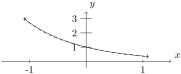
A plot of \(f(x)=e^{-x}\) and \(R_{1,1}(x)\) is
Figure 6.6.3.
And similar to Taylor Series, increasing \(n\) will in general decrease the error in the approximation. Also similar to Taylor Series, the approximate is most accurate near the “center” (in this case, \(x=0\)) and the error typically increases as the distance from this center increases.
Note also that since this is a rational function, there may be places where it is undefined. In this case, \(x=-2\) is a vertical asymptote of the rational function, but not the original function \(y=e^{-x}\text{.}\)

Subsection 6.6.2 A Hermite-Type Rational Approximation

Lastly, we chose a rational function \(R_{m,n}(x)\) that matches both the derivative and function values at interpolated points. We will explore this through an example. Consider \(f(x)=e^{-x}\) and
\begin{equation*} \begin{aligned}R_{4,3}(x)\amp = \frac{a_{0}+a_{1} x + a_{2} x^{2} + a_{3} x^{3}+a_{4} x^{4}}{1 + b_{1} x + b_{2} x^{2}+ b_{3} x^{3}}\end{aligned} \end{equation*}
and we wish to evaluate \(R_{4,3}(x)\) and its derivative at 4 points. Although equally-spaced points can be used, we will use the roots of \(T_{4}(x)\text{,}\) the Chebyshev polynomial. Thus we will take \(x_{0} = -0.9238795325\text{,}\) \(x_{1}= -0.3826834325\text{,}\) \(x_{2}=0.3826834325\text{,}\) and \(x_{3}=0.9238795325\text{.}\) We will solve:
\begin{equation*} \begin{aligned}R_{4,3}(x_{i})\amp = f(x_{i})\amp R'_{4,3}(x)\amp = f'(x_{i})\end{aligned} \end{equation*}
and solve for the \(a\) and \(b\) values. Again, this is not easy to do by hand, but using a CAS, it is reasonably easy. The results are:
\begin{equation*} \begin{aligned}R_{4,3}(x)\amp = \frac{P(x)}{Q(x)}\end{aligned} \end{equation*}
where
\begin{equation*} \begin{aligned}P(x)\amp = 1.000000011- 0.5718840492\,x+ 0.1430276148\,{x}^{2}\\\amp - 0.01904667174\,{x}^{3}+ 0.001181046601\,{x}^{4}\\ Q(x)\amp = 1+ 0.4281159555\,x+ 0.07114374318\,{x}^{2}+ 0.004705683520\,{x}^{3}\end{aligned} \end{equation*}
A plot of the error \(|R(x)-e^{-x}|\) shows that this is quite accurate
NEED PLOT

