Applied Mathematics

Section 3.1 Complex Numbers

The mathematics of complex numbers all arise from defining the imaginary unit \(i\) to be \(\sqrt{-1}\text{.}\) In this section and continuing in the next few are how this fact can generate interesting results

Subsection 3.1.1 Basics of Complex Numbers and the Complex Plane

With the imaginary unit \(i = \sqrt{-1}\text{,}\) we can build up a complex number like \(2 + 3i\text{.}\) Any complex number \(z\) can be simplified with real number arithmetic to a number \(a + bi \text{.}\)

Definition 3.1.1.

A complex number is a number of the form \(z=a+bi\text{,}\) where \(a\) and \(b\) are real numbers and \(i=\sqrt{-1}\text{.}\)
The real part of \(z\) is \(a\) and can be written \(\real{z}\text{.}\) The imaginary part of \(z\) is \(b\) and is written \(\imag{z}\text{.}\)
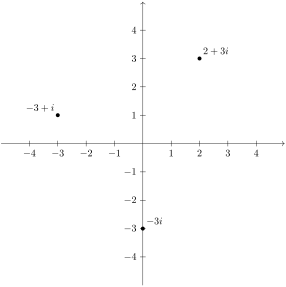
A visual of a complex number can be helpful. The complex plane. In this plane, the horizontal axis is the real part of the number and the vertical axis is the imaginary part. So the complex number \(2 + 3i\) would be plotted at the point \((2,3)\) in this plane.
Figure 3.1.2. The complex plane with sample complex numbers plotted.
Another important concept in complex numbers is that of the complex conjugate of a number \(z\text{.}\) If we use \(z = a+bi\text{,}\) then the complex conjugate is \(\bar{z} = a-bi\text{,}\) which is simply found by changing the sign of the imaginary part of the number.

Subsection 3.1.2 Arithmetic with Complex Numbers

All of the standard operations go through as expected where the final result is often written in the form \(a+bi\text{.}\) If we let
\begin{equation*} z_1=x_1+i y_1 \qquad z_2 = x_2 + i y_2 \end{equation*}
then
\begin{equation*} \begin{aligned} z_1 + z_2 \amp = (x_1+x_2) + i(y_1+y_2)\\ z_1 - z_2 \amp = (x_1-x_2) + i(y_1-y_2) \\ z_1 z_2 \amp = (x_1+iy_1)(x_2+iy_2) \\ \amp = (x_1x_2+iy_1x_2+ix_1y_2+i^{2}y_1y_2)\\ \amp = (x_1x_2-y_1y_2)+i(x_1y_2+x_2y_1) \end{aligned} \end{equation*}
Before finishing with division of complex numbers, if a number \(z=a+bi\) is multiplied by its complex conjugate, then
\begin{equation*} \begin{aligned} z \bar{z} = (a+bi)(a-bi) = a^2 +abi - abi - i^2 b^2 = a^2+b^2 \end{aligned} \end{equation*}
where it is important to note that \(z\bar{z}\) is a real number.
Also, if we have \(1/z_1\text{,}\) then we can write this as
\begin{equation*} \dfrac{1}{z_1} = \dfrac{1}{x_1+iy_1} \end{equation*}
multiply top and bottom by \(\overline{z_1}\text{,}\) the complex conjugate of the number.
\begin{equation*} \begin{aligned} \dfrac{1}{z_1} = \dfrac{1}{z_1}\dfrac{\overline{z_1}}{\overline{z_1}} \amp = \dfrac{1}{x_1+iy_1} \dfrac{x_1-iy_1}{x_1-iy_1} \ \amp= \dfrac{x_1-iy_1}{x_1^{2}+y_1^{2}} \end{aligned} \end{equation*}
and in a similar manner:
\begin{equation*} \begin{aligned} \dfrac{z_1}{z_2} \amp = \dfrac{x_1+iy_1}{x_2+iy_2} \\ \amp = \dfrac{x_1+iy_1}{x_2+iy_2} \dfrac{x_2-iy_2}{x_2-iy_2} \\ \amp = \dfrac{x_1x_2+y_1y_2+i(y_1x_2-y_2x_1)}{x_2^{2}+y_2^{2}} \end{aligned} \end{equation*}
An integer power of a number is found by successive multiplications. For example,
\begin{equation*} z_1^{2} = (x_1+iy_1)(x_1+iy_1)=x_1^{2}-y_1^{2}+2x_1y_1 i \end{equation*}
but we will also see an alternative way to do this below.
There is one other operation that is quite helpful and that is the absolute value. Although you might wonder how to apply the absolute value to a complex number (do we ensure that the signs on each part is positive). Before that, we can interpret the absolute value of a real as if the number is plotted on the number line, then it is the distance from the origin (or \(x=0\)). For example \(|5|=5\) is five units from the origin and \(|-7|=7\) is seven units from the origin.
So in that spirit, we define the absolute value of a complex number as the distance from the origin. For \(z_1= x_1+iy_1\text{,}\) this is
\begin{equation*} |z_1| = \sqrt{x_1^2+y_1^2} \end{equation*}

Observation 3.1.3. Arithmetic of Complex Numbers.

In summary, the following are basic arithmetic operations of complex numbers. If
\begin{equation*} z_1=x_1+i y_1 \qquad z_2 = x_2 + i y_2 \end{equation*}
then
\begin{equation*} \begin{aligned} \bar{z_1} \amp = x_1 - i y_1 \\ z_1 + z_2 \amp = (x_1+x_2) + i(y_1+y_2)\\ z_1 - z_2 \amp = (x_1-x_2) + i(y_1-y_2) \\ z_1 z_2 \amp =(x_1x_2-y_1y_2)+i(x_1y_2+x_2y_1) \\ \frac{z_1}{z_2} \amp = \dfrac{x_1x_2+y_1y_2+i(y_1x_2-y_2x_1)}{x_2^{2}+y_2^{2}} \\ |z_1| \amp = \sqrt{z_1 \bar{z}_1} = \sqrt{x_1^2+y_1^2} \end{aligned} \end{equation*}
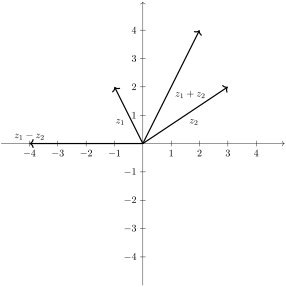
Addition and subtraction of complex numbers have additional geometric meaning. Let’s look at a particular example. Let \(z_1 = -1 + 2i\text{,}\) \(z_2 = 3 + 2i\text{.}\) If we draw these in the complex plane along with vectors of each starting at the origin, then:
Figure 3.1.4. Examples of Addition and Subtraction in the complex plane
Notice that these are just vector addition and subtraction.

Subsection 3.1.3 Polar Form of Complex Numbers

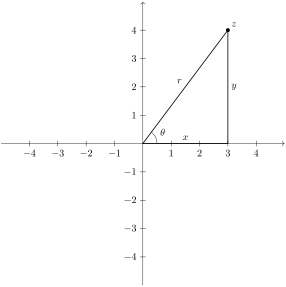
Another important form of a complex number is called the polar form. If we find \(r\text{,}\) the distance from the origin to the point \((x,y)\) and \(\theta\text{,}\) the counterclockwise angle between the positive \(x\) axis and the line segment as shown in the next figure.
Figure 3.1.5.

Proof.

Let
\begin{equation*} \begin{aligned} z \amp = x + i y \\ \amp = r \cos \theta + i r \sin \theta \\ \amp = r (\cos theta + i \sin \theta) \\ \amp = |z| e^{i \theta} \end{aligned} \end{equation*}
where will show that \(e^{i \theta} = \cos \theta + i \sin \theta\) in SECTION ????.

Multiplication of Complex Numbers in Polar Form.

Multiplication of complex numbers have a nice form and geometric interpretation if they are written in polar form. If we write
\begin{equation*} z_1 = r_1 e^{i \theta_1} \qquad z_2 = r_2 e^{i \theta_2} \end{equation*}
then
\begin{equation*} \begin{aligned} z_1 z_2 \amp = |z_1| e^{i \theta_1} |z_2| e^{i \theta_2} \\ \amp = |z_1|\,| z_2| e^{i(\theta_1+\theta_2)} \end{aligned} \end{equation*}
or in other words, the product of two complex numbers is found by multiplying the distances and the angle is the sum.
Example 3.1.7.
Find the the product of \(z_1 = 1+i\) and \(z_2 = 2i\) using the form above.
Solution.
First, we write the two complex numbers in polar form. That is
\begin{equation*} z_1 = \sqrt{2} e^{i\pi/4} \qquad z_2 = 2 e^{i\pi/2} \end{equation*}
Then the product is
\begin{equation*} \begin{aligned} z_1z_2 \amp = r_1 r_2 e^{i(\theta_1+\theta_2)} \\ \amp = 2\sqrt{2} e^{i 3\pi/4} \end{aligned} \end{equation*}
Note that if written in \(a+bi\) form using
\begin{equation*} \begin{aligned} z_1z_2 \amp = 2\sqrt{2}\left(\cos (3\pi/4) + i \sin (3\pi/4)\right) \\ \amp = 2 \sqrt{2} \left( -\frac{\sqrt{2}}{2} + i \frac{\sqrt{2}}{2}\right) \\ \amp = -2 + 2 i \end{aligned} \end{equation*}
This can also be found by multiplying the two numbers directly.

Powers and Roots of Complex Numbers in Polar Form.

The polar form of a complex number is also helpful for powers and roots. First, writing a number in polar form and then raising that to the power \(n\) results in
\begin{equation*} z^n = (|z| e^{i\theta})^n = |z|^n e^{in \theta} \end{equation*}
For example, if \(z=1+i=\sqrt{2}e^{i\pi/4}\text{,}\) then powers of \(z\) can be written as
\begin{equation*} z^{n} = (\sqrt{2})^{n} e^{i n \pi/4} \end{equation*}
If \(n=6\text{,}\) then
\begin{equation*} z^6 = (\sqrt{2})^6 e^{i 6 \pi/4} = 8 e^{i 3\pi/2}. \end{equation*}
This can then be converted back to the standard form as
\begin{equation*} z^6 = 8 (\cos (3\pi/2) + i \sin(3\pi/2)) = 8 (0 + i (-1)) = -8i \end{equation*}
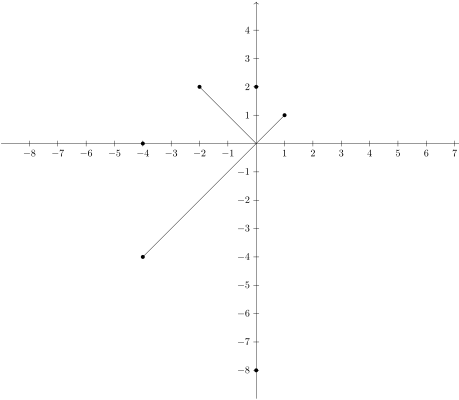
A plot of the powers have some interesting properties. Consider the first 6 powers of \(z=1+i\)
Figure 3.1.8.
This can be interpreted as raising the distance to the \(n\text{th}\) power and rotating the angle \(n\) times around. For example, the plot about actually shows the number and its 2nd and 3rd power.
If the power is a fraction, we can interpret the same way. For example, the square root of \(z\) can be written:
\begin{equation*} \sqrt{z} = \sqrt{r e^{i\theta}} = \sqrt{r} e^{i\theta/2} \end{equation*}
What this means is that to find the square root of a complex number, you take the square root of the distance and then return the number with angle half of the input.
Example 3.1.9.
Find the square root of \(z=-1+\sqrt{3}i\text{.}\) Note that \(|z|=\sqrt{1^{2}+(-\sqrt{3})^{2}}= \sqrt{4}=2\) and that the angle (argument) is \(2\pi/3\text{.}\) The resultant would have distance \(\sqrt{2}\) and the angle would be \(\pi/3\) so
\begin{equation*} \sqrt{z} = \sqrt{2}e^{i\pi/3} \end{equation*}

Subsection 3.1.4 Roots of unity

An interesting function to study in complex numbers is \(f(z)=z^{n}-1\) for positive integers \(n\text{.}\) When \(n=2\text{,}\) we get the function \(x^{2}-1\) which isn’t that interesting, but not bad. Note that the roots of this are \(x=\pm 1\text{.}\) Let’s look at the solution to \(f(z)=z^{3}-1\text{.}\)
A good way to do this is to recall that we can write \(z\) in its polar form or
\begin{equation*} z=re^{i\theta} \end{equation*}
and then we want to solve
\begin{equation*} z^{3}-1 = r^{3} e^{3i\theta}-1 \end{equation*}
Since we can write \(1=1e^{0 i}\text{,}\) then
\begin{equation*} r^{3} e^{3i\theta} = e^{0i} \end{equation*}
results in \(r^{3}=1\) or \(r=1\) and \(\theta=0\text{.}\) This is the number \(z_1=1\) and we know that \(1^{3}-1=0\text{.}\) What else?
We can also write \(1=e^{2\pi i}\) so
\begin{equation*} 3i \theta = 2\pi i \end{equation*}
or \(\theta=2\pi/3\text{,}\) so another root of \(f\) is
\begin{equation*} z_2=e^{2\pi/3 i} \end{equation*}
and lastly, we can also write \(1=e^{4\pi i}\) so another root when \(\theta=4\pi/3\) or the number
\begin{equation*} z_3=e^{4\pi/3} \end{equation*}
These points are on the unit circle and equally spaced with \(z=1\) a root. This is true in general for functions of the form \(f(z)=z^{n}-1\text{,}\) which will have the roots on the unit circle equally spaced \(2\pi/n\) radians apart from each other.
The solutions in the complex plane to the equation \(f(z)=z^n-1\) are called the roots of unity. We will use the technique above to find the solution.
First, recall that the fundamental theorem of algebra states that there are exactly \(n\) complex solutions to a degree \(n\) polynomial (including multiplicities), so we expect \(n\) solutions to this.
\begin{equation*} \begin{aligned} z^n \amp = 1 \\ \amp = e^{2k\pi i} \qquad \text{for $k=0,1,2,\ldots,n-1$} \\ z \amp = e^{(2\pi k)/n i} = \cos \left(\frac{2k\pi}{n}\right) + i \sin \left(\frac{2k\pi}{n}\right) \end{aligned} \end{equation*}
And these values are on the unit circle, one of which is \(z=1+0i\) and the others are equally spaced around the circle.

Example 3.1.10.

If \(n=3\text{,}\) then the values are
\begin{equation*} \begin{aligned} z \amp = 1+0i, \cos(2\pi/3) + i \sin (2\pi/3), \cos(4 \pi/3) + i \sin (4\pi/3) \\\ \amp = 1+0i, -\frac{1}{2} + i\frac{\sqrt{3}}{2}, -\frac{1}{2} - i\frac{\sqrt{3}}{2} \end{aligned} \end{equation*}